What are Dosage Forms: In pharmaceutical sciences, drugs are rarely administered in their pure chemical form. Instead, they are formulated into dosage forms, which are designed to ensure safe, effective, and convenient delivery of the drug to the body. The concept of dosage forms is central to pharmaceutics because it directly influences drug stability, bioavailability, patient compliance, and therapeutic outcome.
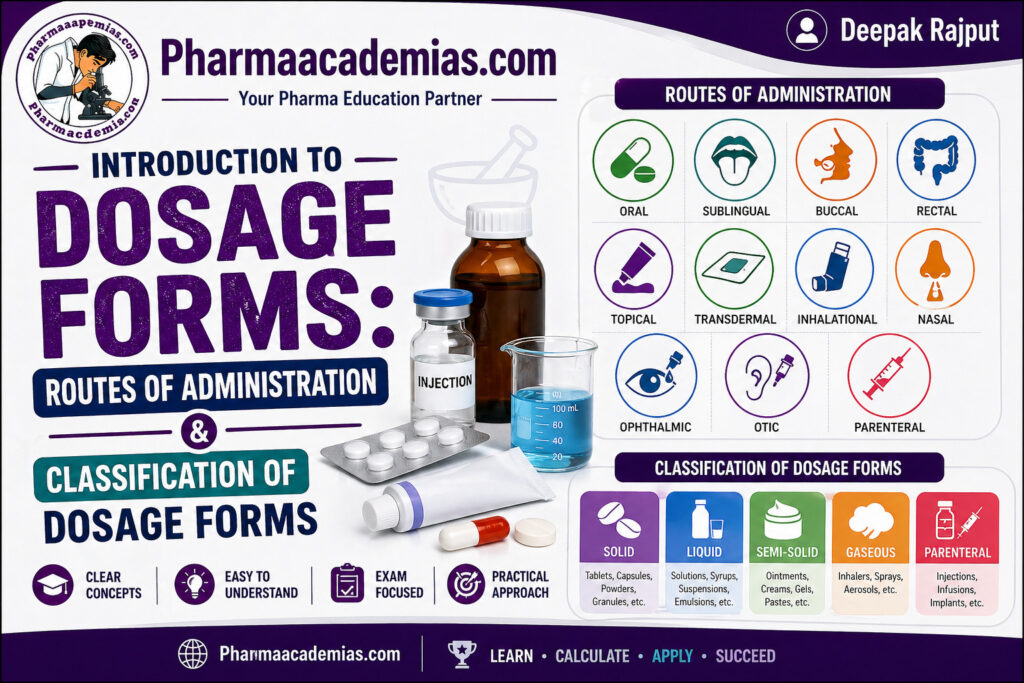
A proper understanding of dosage forms, along with the various routes of administration, is essential for pharmacists and healthcare professionals, as it helps in selecting the most appropriate method of drug delivery for a particular patient and condition.
What are Dosage Forms?
A dosage form can be defined as the physical form in which a drug is produced and administered, containing both the active pharmaceutical ingredient (API) and suitable excipients. These excipients are added to enhance properties such as stability, taste, absorption, and appearance.
Dosage forms are designed to:
- protect the drug from environmental degradation,
- mask unpleasant taste or odor,
- provide accurate dosing,
- and facilitate ease of administration.
Thus, the development of dosage forms bridges the gap between drug discovery and patient use.
Routes of Drug Administration
The route of administration refers to the pathway by which a drug is taken into or applied to the body. The choice of route significantly affects the onset, intensity, and duration of drug action.
1. Oral Route
The oral route is the most common and convenient method of drug administration. Drugs are swallowed and absorbed through the gastrointestinal tract.
This route is preferred due to its simplicity and patient compliance. However, it is influenced by factors such as first-pass metabolism in the liver, gastric pH, and food interactions. It is not suitable for drugs that are unstable in acidic environments or those requiring rapid action.
2. Parenteral Route
Parenteral administration involves delivering drugs directly into the body tissues or bloodstream using injections. This route bypasses the gastrointestinal tract and first-pass metabolism.
It includes routes such as:
- intravenous (IV),
- intramuscular (IM),
- subcutaneous (SC).
Parenteral administration provides rapid onset of action and precise control over drug levels, making it essential in emergency situations. However, it requires sterile conditions and trained personnel.
3. Topical Route
In this route, drugs are applied directly to the skin or mucous membranes to produce local effects. Examples include ointments, creams, and lotions.
Topical administration minimizes systemic side effects and is commonly used in dermatology. However, drug absorption may vary depending on skin condition and formulation.
4. Inhalation Route
The inhalation route involves administration of drugs through the respiratory tract, allowing them to reach the lungs directly.
This route provides rapid absorption due to large surface area and rich blood supply. It is widely used in the management of respiratory conditions such as asthma.
5. Sublingual and Buccal Route
Drugs administered under the tongue (sublingual) or between the gum and cheek (buccal) are absorbed directly into the bloodstream.
This route bypasses first-pass metabolism and provides quick onset of action, making it suitable for drugs like nitroglycerin.
6. Rectal Route
In this route, drugs are administered via the rectum, usually in the form of suppositories or enemas. It is useful in patients who are vomiting, unconscious, or unable to swallow.
Classification of Dosage Forms
Dosage forms can be classified in several ways, but the most common method is based on physical state
1. Solid Dosage Forms
Solid dosage forms are the most stable and widely used forms. They provide accurate dosing and are convenient for storage and transportation.
Examples include:
These forms are generally administered orally and may be designed for immediate or controlled release.
2. Liquid Dosage Forms
Liquid dosage forms are useful for patients who have difficulty swallowing solids, such as children and elderly individuals.
They include:
- solutions (clear, homogeneous mixtures),
- suspensions (insoluble particles dispersed in liquid),
- emulsions (mixtures of two immiscible liquids).
Liquid forms allow flexibility in dosing but may have stability issues compared to solids.
Semi-solid preparations are mainly used for topical application. They provide prolonged contact with the site of application and can deliver drugs locally.
Common examples are:
- ointments,
- creams,
- gels,
- pastes.
Their consistency allows easy application and absorption through the skin.
4. Gaseous Dosage Forms
These dosage forms are administered via inhalation and are used primarily for respiratory therapy.
Examples include:
- aerosols,
- inhalers,
- nebulizers.
They offer rapid onset of action due to direct delivery to the lungs.
Conclusion
Dosage forms and routes of administration are fundamental aspects of pharmaceutical science that determine how effectively a drug reaches its site of action. The selection of an appropriate dosage form and route depends on various factors such as the nature of the drug, desired therapeutic effect, and patient condition. A thorough understanding of these concepts ensures optimal drug delivery, improved patient compliance, and enhanced therapeutic outcomes.
Editorial Note
This article has been carefully researched and written by Deepak Rajput with a focus on accuracy, clarity, and evidence-based healthcare information. Pharmaacademias.com