The metric system of weights and measures and alligation calculations are fundamental concepts in pharmacy, pharmacology, and pharmaceutical sciences. These topics are essential for drug dosage calculations, solution preparation, and compounding, making them highly important for students, researchers, and professionals.
PART 1: METRIC SYSTEM OF WEIGHTS AND MEASURES
What is the Metric System?
The metric system is a decimal-based standardized system of measurement used globally in science and medicine. It is formally known as the International System of Units, which ensures consistency and accuracy in calculations.
Base Units in Metric System
| Physical Quantity | Unit Name | Symbol |
| Length | meter | m |
| Mass | gram | g |
| Volume | liter | L |
Metric Prefixes (Multiples & Submultiples)
Understanding prefixes is key for unit conversion in pharmacy:
| Prefix | Symbol | Power | Value |
| kilo | k | 10³ | 1000 |
| hecto | h | 10² | 100 |
| deca | da | 10¹ | 10 |
| base | — | 10⁰ | 1 |
| deci | d | 10⁻¹ | 0.1 |
| centi | c | 10⁻² | 0.01 |
| milli | m | 10⁻³ | 0.001 |
| micro | μ | 10⁻⁶ | 0.000001 |
Metric Units in Pharmacy Practice
Weight Conversion
- 1 kg = 1000 g
- 1 g = 1000 mg
- 1 mg = 1000 μg
Volume Conversion
- 1 L = 1000 mL
- 1 mL = 1 cubic centimeter (cc)
Length Conversion
- 1 m = 100 cm = 1000 mm
Unit Conversion Techniques (Step-by-Step)
Example:
Convert 2.5 g into mg:
1 g = 1000 mg
2.5 × 1000 = 2500 mg
Advantages of Metric System in Pharmacy
- Easy decimal-based calculations
- Reduces medication errors
- Universal standard in healthcare
- Essential for accurate drug formulation
PART 2: ALLIGATION CALCULATIONS IN PHARMACY
What is Alligation?
Alligation is a mathematical technique used to:
- Mix substances of different concentrations
- Obtain a desired concentration or strength
It is widely used in:
- Pharmaceutical compounding
- Solution dilution
- Alcohol and syrup preparation
Types of Alligation
Alligation Medial
Used to calculate average concentration
Alligation Alternate
Used to determine mixing ratio of components
Alligation Medial Formula
Mean Strength=

Example:
Mix 10 mL of 20% solution with 20 mL of 40% solution:
Active ingredient:
- (10 × 20) + (20 × 40) = 1000
Total volume = 30 mL
Mean strength = 33.33%
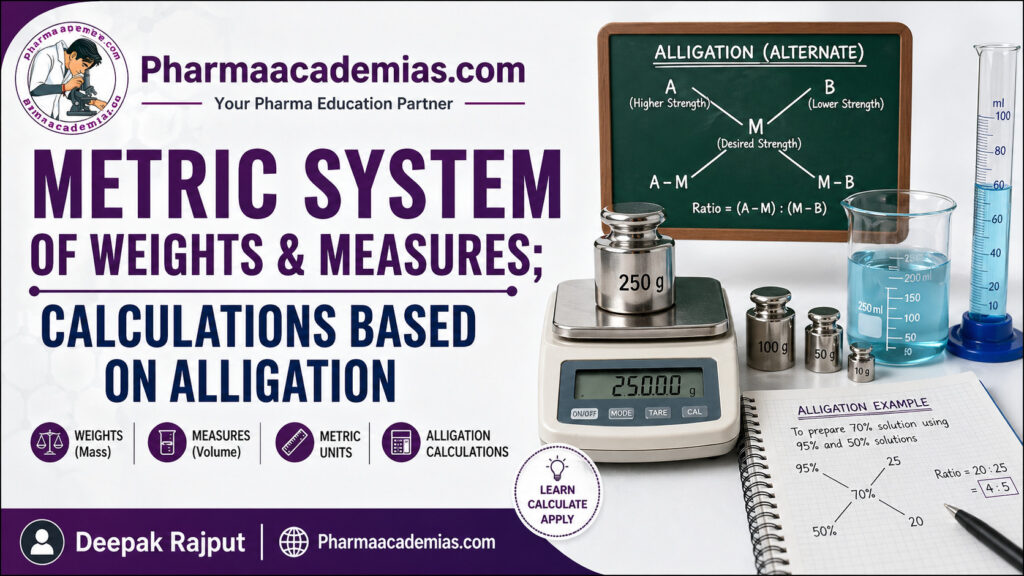
Alligation Alternate Method (Shortcut Technique)
Formula:
(H – M) : (M – L)
Where:
- H = Higher concentration
- M = Desired concentration
- L = Lower concentration
Example 1:
Prepare 30% solution using 20% and 50%
(50 − 30) : (30 − 20) = 20 : 10 = 2 : 1
Example 2:
Prepare 6% solution using 10% and 2%
(10 − 6) : (6 − 2) = 4 : 4 = 1 : 1
Example 3 (Pharmacy Application):
Prepare 100 mL of 25% solution using 10% and 40%
Ratio = 1 : 1
Take 50 mL of each solution
Applications of Alligation in Pharmacy
- Drug dilution and concentration adjustment
- IV fluid preparation
- Syrup and suspension formulation
- Compounding of topical formulations
Advantages of Alligation Method
- Quick and efficient
- Reduces calculation errors
- Ideal for pharmacy students and practitioners
Limitations
- Not suitable for multiple complex mixtures
- Requires clear understanding of percentage strength
Final Conclusion
The metric system of weights and measures provides a standardized and precise framework for pharmaceutical calculations, while alligation calculations offer a fast and practical method for preparing solutions of desired concentrations. Together, they form the backbone of pharmaceutical compounding, dosage accuracy, and drug safety.
Editorial Note
This article has been carefully researched and written by Deepak Rajput with a focus on accuracy, clarity, and evidence-based healthcare information. Pharmaacademias.com