
Authentication of Herbal Materials: The quality, safety, and efficacy of herbal medicines depend fundamentally on the correct selection, identification, and authentication of herbal raw materials. Errors at this stage can lead to adulteration, therapeutic failure, toxicity, and regulatory issues. Therefore, these processes are considered critical steps in pharmacognosy and herbal drug standardization.
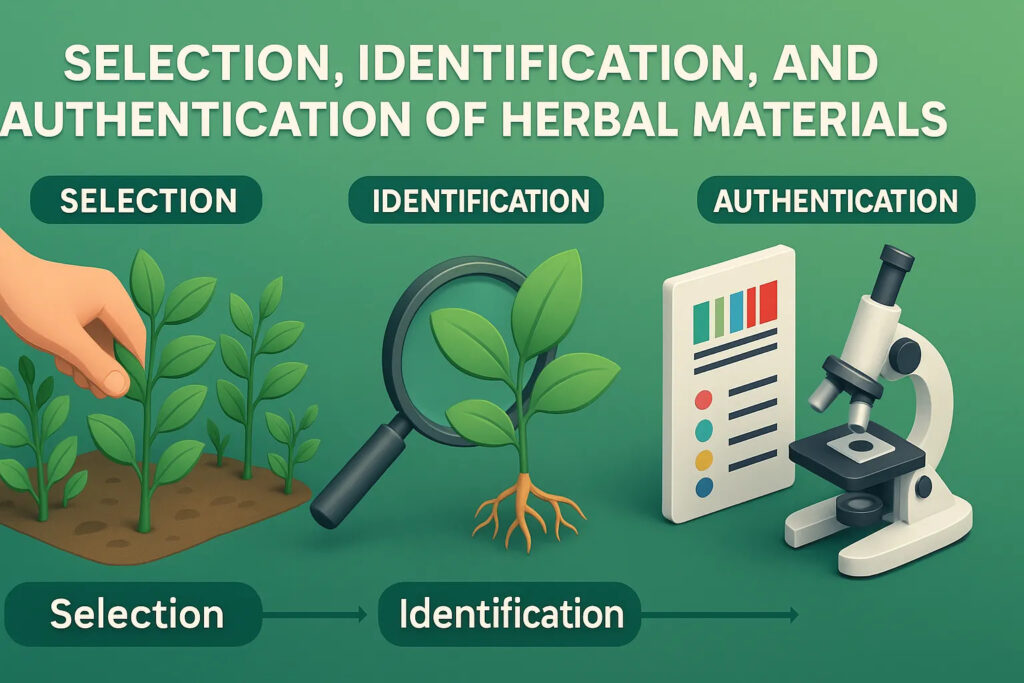
With the increasing global demand for herbal products, ensuring the authenticity and quality of plant materials has become more important than ever in pharmaceutical sciences.
1. Selection of Herbal Materials
Selection refers to the process of choosing appropriate plant species and plant parts for medicinal use based on their quality, therapeutic value, and regulatory acceptance.
Detailed Explanation:
The selection process begins with the identification of the correct plant species and continues with the evaluation of its quality, source, and suitability for intended use. It is a crucial step to ensure that only genuine, effective, and safe raw materials are used in herbal drug preparation.
Criteria for Selection:
- Botanical Identity
- Correct plant species must be selected
- Avoid closely related or morphologically similar species
Part of the Plant Used
- Leaves, roots, bark, flowers, seeds, etc.
- Selection depends on the location of active constituents
Geographical Source
- Different regions may influence phytochemical composition
- Example: altitude and climate affect alkaloid content
Quality of Raw Material
- Free from contaminants (dust, microbes, pesticides)
- Free from adulterants and substitutes
Stage of Growth and Harvesting Time
- Maximum concentration of active constituents at specific stages
- Example: roots collected during dormancy
Organoleptic Properties
- Color, odor, taste, texture
Traditional and Scientific Evidence
- Ethnomedicinal use
- Pharmacological validation
Regulatory Acceptance
- Listed in pharmacopoeias (IP, BP, USP, WHO monographs)
2. Identification of Herbal Materials
Identification is the process of recognizing and confirming the identity of a herbal material based on its morphological, anatomical, and chemical characteristics.
Detailed Explanation:
Identification ensures that the correct plant species is used. It involves both macroscopic (external) and microscopic (internal) examination, along with chemical and analytical methods.
A. Macroscopic Identification
This involves the study of visible characteristics of the plant or plant part.
Parameters:
- आकार (size and shape)
- रंग (color)
- गंध (odor)
- स्वाद (taste)
- सतह (surface characteristics)
Example Features:
- Leaf shape and venation
- Bark texture
- Root structure
B. Microscopic Identification
Microscopy is used to study internal structures of plant tissues.
Key Features:
- Epidermal cells
- Stomata type
- Trichomes (hair structures)
- Vascular tissues (xylem, phloem)
- Calcium oxalate crystals
Importance:
- Helps detect adulteration
- Useful for powdered drugs where macroscopic features are lost
C. Chemical Identification
Chemical tests are used to detect the presence of specific phytoconstituents.
Methods:
- Color reactions
- Precipitation tests
- Fluorescence analysis
Examples:
- Alkaloid detection (Dragendorff’s test)
- Flavonoid tests
D. Instrumental Identification
Modern analytical techniques are used for precise identification.
Techniques:
- Chromatography (TLC, HPLC, GC)
- Spectroscopy (UV, IR, NMR, Mass spectrometry)
Advantages:
- High accuracy and sensitivity
- Quantitative analysis of active constituents
3. Authentication of Herbal Materials
Authentication is the process of verifying that the herbal material is genuine, pure, and free from adulteration or substitution.
Detailed Explanation:
Authentication goes beyond identification. It ensures that the material is true to its claimed identity and meets quality standards. It involves comparison with standard references and pharmacopoeial specifications.
Methods of Authentication:
1. Pharmacognostic Evaluation
- Combines macroscopic and microscopic analysis
- Compares with standard descriptions
2. Physicochemical Analysis
- Moisture content
- Ash values (total ash, acid-insoluble ash)
- Extractive values
3. Phytochemical Analysis
- Identification of active constituents
- Quantification of marker compounds
4. Chromatographic Fingerprinting
- TLC/HPTLC profiles
- Provides a characteristic pattern for each herb
5. DNA Barcoding (Molecular Authentication)
- Uses genetic markers for identification
- Highly reliable and specific
Advantages:
- Detects adulteration and substitution
- Works even with processed or powdered materials
Common Types of Adulteration:
- Substitution with inferior species
- Addition of exhausted drugs
- Mixing with foreign matter (sand, stones)
- Use of synthetic chemicals
- Accidental adulteration due to misidentification
Importance of Authentication:
- Ensures safety and efficacy
- Prevents toxicity and adverse effects
- Maintains consistency in herbal formulations
- Essential for regulatory approval
- Builds consumer trust
Quality Control and Standardization
Selection, identification, and authentication are integral parts of quality control in herbal drug production.
Key Aspects:
- Standardization of raw materials
- Use of reference standards
- Compliance with pharmacopoeial guidelines
- Implementation of GMP, GACP
Challenges in Identification and Authentication
- Similar morphology among plant species
- Variability in phytochemical composition
- Lack of standard reference materials
- Adulteration and substitution in the market
- Degradation during storage
Conclusion
Selection, identification, and authentication of herbal materials are critical steps in ensuring the quality, safety, and efficacy of herbal medicines. These processes require a combination of traditional knowledge and modern scientific techniques. With advancements in analytical and molecular methods, the reliability of herbal drug authentication has significantly improved, supporting the development of standardized and globally acceptable herbal products.