Gravimetric analysis is one of the oldest and most accurate quantitative analytical techniques used in chemistry and pharmaceutical sciences. It is based on the measurement of mass to determine the amount of a particular analyte present in a sample. Due to its high precision, reliability, and minimal requirement for sophisticated instrumentation, gravimetric analysis continues to be widely used in pharmaceutical quality control, chemical analysis, and research laboratories.
In pharmaceutical practice, gravimetric methods are essential for assaying drugs, determining purity, analyzing excipients, and validating analytical procedures. The technique is particularly valuable when high accuracy is required, as it is less prone to instrumental errors compared to modern analytical techniques.
Definition
Gravimetric analysis is a quantitative analytical method in which the amount of an analyte is determined by measuring its mass, either after converting it into a pure, stable, and insoluble compound or by measuring the loss of mass during a chemical process.
In simple terms, it involves isolating a substance of known composition and weighing it accurately to determine the amount of the original analyte.
Principle of Gravimetric Analysis
The fundamental principle of gravimetric analysis is based on the law of conservation of mass, which states that mass is neither created nor destroyed during a chemical reaction.
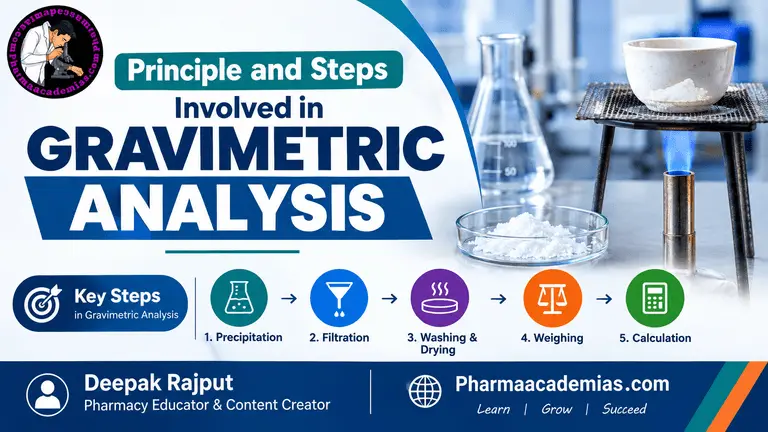
In most gravimetric methods, the analyte is converted into a sparingly soluble precipitate of known chemical composition. This precipitate is then:
- Filtered
- Washed to remove impurities
- Dried or ignited to a constant weight
- Weighed accurately
From the mass of the precipitate, the amount of analyte is calculated using stoichiometric relationships.
For example, chloride ions can be estimated by precipitating them as silver chloride (AgCl), which is then filtered, dried, and weighed.
Types of Gravimetric Analysis
Gravimetric analysis can be broadly classified into different types based on the method of measurement.
1. Precipitation Gravimetry
This is the most commonly used method, where the analyte is converted into an insoluble precipitate. The precipitate must be pure, stable, and easily filterable.
A typical example includes the estimation of sulfate ions as barium sulfate (BaSO₄). The accuracy of this method depends on complete precipitation, proper washing, and avoidance of contamination.
2. Volatilization Gravimetry
In this method, the analyte is converted into a volatile product, and the amount is determined either by:
- Measuring the loss in weight, or
- Collecting and weighing the volatile product
For example, determination of moisture content in a sample involves measuring the loss of weight upon heating.
3. Electrogravimetry
This technique involves electrochemical deposition of the analyte onto an electrode, followed by weighing the electrode before and after deposition. It is commonly used for metal analysis, such as copper or nickel.
Steps Involved in Gravimetric Analysis
Gravimetric analysis follows a systematic and precise procedure to ensure accuracy and reproducibility.
The process begins with sample preparation, where the analyte is brought into solution. This is followed by precipitation, achieved by adding a suitable reagent that forms an insoluble compound with the analyte.
The precipitate is then subjected to digestion, a process in which it is allowed to stand in the mother liquor to improve particle size and filterability. Larger particles are easier to filter and less likely to trap impurities.
Next, the precipitate is filtered using appropriate filter media, such as filter paper or sintered glass crucibles. It is then washed thoroughly to remove adhering impurities or excess reagents.
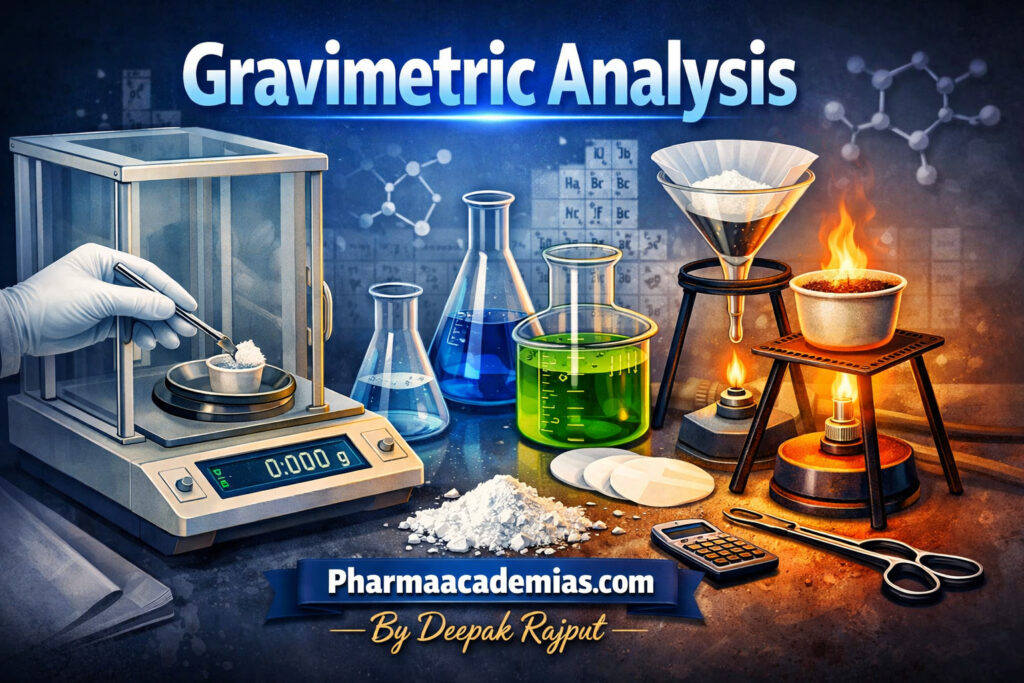
After washing, the precipitate is dried or ignited to remove moisture and convert it into a stable form. Finally, it is cooled in a desiccator and weighed accurately using an analytical balance.
The weight obtained is used to calculate the amount of analyte using stoichiometric calculations.
Requirements for a Good Gravimetric Method
For accurate results, the precipitate formed must have specific characteristics. It should be insoluble under experimental conditions, possess a known and definite composition, and be free from impurities. It should also be easily filterable and stable upon drying or ignition.
The reagent used must be selective, reacting only with the analyte and not with other components in the mixture. Additionally, experimental conditions such as temperature, pH, and concentration must be carefully controlled.
Sources of Error
Despite its accuracy, gravimetric analysis can be affected by several errors if not performed carefully.
Errors may arise due to incomplete precipitation, where some analyte remains in solution. Contamination of the precipitate with impurities, known as co-precipitation, can also affect accuracy. Improper washing may leave behind adsorbed impurities, while excessive washing may lead to loss of precipitate.
Other sources of error include mechanical losses during filtration, improper drying, or weighing errors due to moisture absorption.
Applications in Pharmacy
Gravimetric analysis has numerous applications in pharmaceutical sciences. It is used for assay of drugs and pharmaceutical substances, particularly where high accuracy is required. It is also employed in the determination of impurities, such as sulfate, chloride, or heavy metals in pharmaceutical products.
In quality control laboratories, gravimetric methods are used to validate analytical techniques, standardize reagents, and ensure compliance with pharmacopoeial standards. Additionally, it is applied in moisture determination, ash content analysis, and formulation studies.
Advantages and Limitations
Gravimetric analysis offers several advantages, including high accuracy, simplicity, and independence from complex instruments. It is considered a primary analytical method, often used to standardize other techniques.
However, it is time-consuming and requires careful handling and precision. It may not be suitable for trace analysis or samples with very low analyte concentration.
Conclusion
Gravimetric analysis remains a cornerstone of classical analytical chemistry, providing highly accurate and reliable quantitative results. Its application in pharmacy is significant, particularly in drug analysis, quality control, and validation processes. A thorough understanding of its principles, procedures, and limitations is essential for pharmacy students and professionals involved in analytical and pharmaceutical sciences.
Key Concepts for Study
- Based on mass measurement
- Includes precipitation, volatilization, and electrogravimetry
- Requires pure, stable precipitate
- Highly accurate but time-consuming
References
- Vogel, A.I. Textbook of Quantitative Chemical Analysis, 5th Edition
- Beckett, A.H., Stenlake, J.B. Practical Pharmaceutical Chemistry
- Indian Pharmacopoeia, 2022
- Harris, D.C. Quantitative Chemical Analysis, 9th Edition