Processing of herbal raw materials is a critical step in the preparation of herbal medicines. It involves a series of operations carried out after harvesting to preserve, stabilize, and enhance the quality of plant materials. Proper processing ensures that the active constituents are retained, contamination is minimized, and the material becomes suitable for storage, transport, and formulation.
In pharmaceutical sciences, processing plays a vital role in maintaining the efficacy, safety, and standardization of herbal drugs.
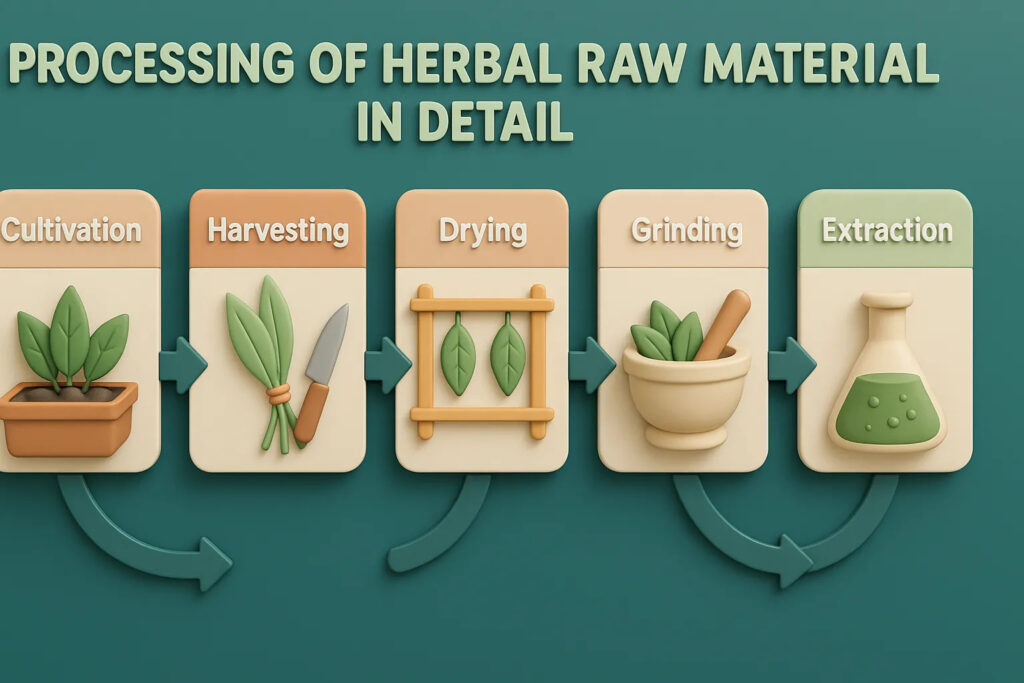
Processing of Herbal Raw Materials
1. Definition of Processing
Processing of herbal raw materials can be defined as:
The series of operations applied to freshly collected or harvested plant materials to convert them into a stable, usable, and standardized form without significant loss of active constituents.
2. Objectives of Processing
The primary objectives of processing herbal materials include:
- Preservation of active phytoconstituents
- Prevention of microbial growth and spoilage
- Reduction of moisture content
- Removal of unwanted materials (foreign matter, dirt)
- Enhancement of stability and shelf-life
- Facilitation of storage, transport, and formulation
3. Steps Involved in Processing of Herbal Raw Materials
Processing involves multiple sequential steps, each of which significantly influences the final quality of the herbal drug.
3.1 Collection and Harvesting
This is the first and most crucial step in processing.
Key Considerations:
- Correct identification of plant species
- Selection of appropriate plant part (leaf, root, bark, etc.)
- Harvesting at the optimal stage of growth
- Seasonal timing (e.g., roots in dormant phase, leaves before flowering)
Importance:
Improper harvesting can lead to loss of active constituents and reduced therapeutic efficacy.
3.2 Cleaning and Washing
After collection, plant materials are cleaned to remove impurities.
Methods:
- Manual removal of foreign matter
- Washing with water to remove soil, dust, and debris
Precautions:
- Avoid excessive washing to prevent loss of water-soluble constituents
- Use clean water to avoid contamination
3.3 Drying
Drying is one of the most important processing steps.
Purpose:
- Reduce moisture content
- Prevent microbial growth and enzymatic degradation
Methods of Drying:
- Natural Drying: Sun drying, Shade drying
- Artificial Drying: Hot air oven drying, Vacuum drying, Freeze drying (lyophilization)
Factors Affecting Drying:
- Temperature
- Humidity
- Air circulation
- Thickness of plant material
Importance: Proper drying preserves color, aroma, and active constituents.
3.4 Size Reduction (Comminution)
This involves reducing the size of plant material into smaller pieces.
Methods:
- Cutting
- Grinding
- Pulverization
Advantages:
- Increases surface area
- Facilitates extraction
- Improves uniformity
3.5 Sieving and Grading
After size reduction, materials are separated based on particle size.
Purpose:
- Ensure uniform particle size
- Remove coarse or fine unwanted particles
3.6 Stabilization
Stabilization involves inactivating enzymes that may degrade active constituents.
Methods:
- Heat treatment
- Use of chemical stabilizers
- Rapid drying
Importance:
Prevents enzymatic degradation (e.g., hydrolysis of glycosides)
3.7 Storage
Proper storage is essential to maintain quality.
Conditions:
- Cool and dry environment
- Protection from light and moisture
- Use of airtight containers
Risks During Storage:
- Microbial contamination
- Insect infestation
- Loss of volatile components
3.8 Packaging
Packaging protects herbal materials from environmental factors.
Types:
- Glass containers
- Plastic containers
- Moisture-resistant packaging
Requirements:
- Proper labeling
- Protection from contamination
4. Advanced Processing Techniques
Modern pharmaceutical industries use advanced techniques to improve quality and efficiency.
Techniques:
- Freeze Drying (Lyophilization): Preserves heat-sensitive compounds
- Spray Drying: Used for extract powders
- Supercritical Fluid Extraction: Efficient extraction of active compounds
- Microwave-Assisted Processing: Faster and energy-efficient
5. Factors Affecting Processing of Herbal Materials
- Nature of plant material
- Type of active constituents
- Environmental conditions
- Processing method used
- Duration of processing
6. Importance of Proper Processing
Proper processing ensures:
- Retention of therapeutic activity
- Improved shelf-life
- Reduction of contamination
- Standardization of herbal drugs
- Better patient safety and efficacy
7. Challenges in Processing
- Loss of active constituents due to improper drying
- Degradation by enzymes
- Contamination during handling
- Lack of standardization
- Variability in processing techniques
Conclusion
Processing of herbal raw materials is a crucial step that directly affects the quality and effectiveness of herbal medicines. Each stage, from harvesting to storage, must be carefully controlled to ensure the preservation of active constituents and prevention of contamination. With the integration of modern technologies and standard guidelines, the processing of herbal materials can be optimized to produce high-quality, safe, and effective herbal products.