Large Volume Parenterals: Parenteral dosage forms are sterile pharmaceutical preparations intended for administration by injection through routes such as intravenous, intramuscular, or subcutaneous routes. Because these preparations bypass the natural protective barriers of the body, they must meet very strict standards of sterility, purity, and safety. Among the various types of parenteral products, Large Volume Parenterals (LVPs) and Lyophilized products are particularly important in modern pharmaceutical therapy.
Large volume parenterals are sterile solutions intended for intravenous administration in relatively large volumes, usually greater than 100 mL. These formulations are widely used for fluid replacement, electrolyte balance, parenteral nutrition, and drug delivery. On the other hand, lyophilized products are sterile preparations obtained by freeze-drying drug solutions to produce a dry, porous powder that can be reconstituted before administration. This technique is commonly used for drugs that are unstable in aqueous solutions.
Both LVPs and lyophilized products play a significant role in hospital therapy and pharmaceutical manufacturing, and their formulation requires strict adherence to pharmaceutical standards.
Large Volume Parenterals (LVP)
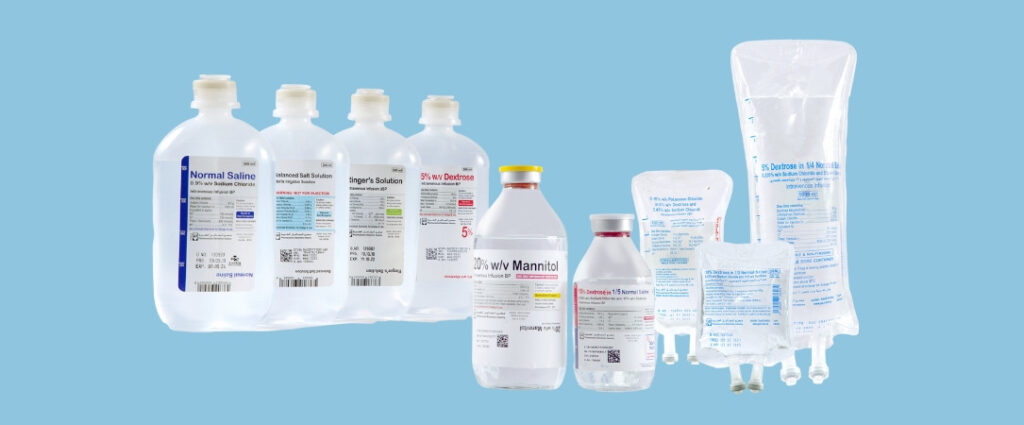
Large Volume Parenterals (LVPs) are sterile, pyrogen-free solutions intended for intravenous administration in volumes greater than 100 mL. These preparations are usually supplied in containers such as glass bottles or plastic infusion bags and are administered by intravenous infusion over a period of time.
Unlike small-volume injections, LVPs are typically used for fluid replacement, electrolyte therapy, nutrient supply, and dilution of other injectable drugs.
Characteristics of LVPs
Large volume parenterals must meet several important requirements to ensure patient safety and therapeutic effectiveness.
One of the most important characteristics is sterility, since contamination can lead to serious infections. LVPs must also be free from pyrogens, particularly bacterial endotoxins, because even small amounts can produce fever and severe reactions when large volumes are administered.
Another critical requirement is isotonicity, meaning that the osmotic pressure of the solution should be similar to that of blood plasma to prevent damage to blood cells. LVPs must also be clear and free from particulate matter, since particles may cause embolism or irritation.
In addition, these products must be chemically stable and compatible with the container material throughout their shelf life.
Types of Large Volume Parenterals
Large volume parenterals are commonly classified according to their therapeutic purpose.
Electrolyte Solutions
These solutions contain essential electrolytes required for maintaining fluid and electrolyte balance in the body.
Examples include:
- Sodium chloride solution
- Ringer’s solution
- Ringer’s lactate solution
These formulations are frequently used for treating dehydration and restoring electrolyte balance.
Nutrient Solutions
Nutrient solutions provide essential nutrients to patients who are unable to consume food orally.
Examples include:
- Dextrose solution
- Amino acid infusion
- Lipid emulsions
These preparations are often used in parenteral nutrition therapy for critically ill patients.
Plasma Expanders
Plasma expanders are used to maintain blood volume in cases of severe blood loss or shock.
Examples include dextran solutions and gelatin-based solutions.
Components of Large Volume Parenterals
The formulation of LVPs includes several important components.
Active Ingredients
The active ingredient may be an electrolyte, nutrient, or therapeutic drug depending on the intended purpose of the formulation.
Vehicle
The most commonly used vehicle is Water for Injection (WFI), which must be free from microorganisms, pyrogens, and particulate matter.
Isotonicity Adjusting Agents
Substances such as sodium chloride or dextrose are used to maintain osmotic pressure similar to body fluids.
Stabilizers
Stabilizers may be added to improve the chemical stability of the formulation during storage.
It should be noted that preservatives are generally not added to LVPs, because the large volume administered could lead to toxicity.
Manufacturing of Large Volume Parenterals
The manufacturing of LVPs requires strict aseptic conditions. The process typically involves several stages.
First, the ingredients are dissolved in water for injection to form the solution. The solution is then filtered to remove particulate matter and microorganisms. After filtration, the sterile solution is filled into containers such as glass bottles or plastic infusion bags.
The filled containers are sealed and then sterilized, usually by autoclaving using moist heat. Finally, the products undergo rigorous quality control testing before being released for use.
Quality Control Tests for LVPs
Large volume parenterals must undergo several quality tests to ensure safety and compliance with pharmacopeial standards.
Important tests include:
- Sterility test
- Pyrogen or endotoxin test
- Particulate matter test
- pH determination
- Assay of active ingredients
These tests ensure that the product is safe for intravenous administration.
Lyophilized Products
Lyophilized products are sterile pharmaceutical preparations obtained by removing water from a frozen drug solution through a process called freeze-drying or lyophilization. The result is a dry, porous powder that can be easily reconstituted with a sterile solvent before administration.
Lyophilization is widely used for drugs that are unstable in liquid form, including many antibiotics, vaccines, and biological products.
Principle of Lyophilization
Lyophilization works on the principle of sublimation, in which ice changes directly into vapor without passing through the liquid phase. This process removes water from the product while preserving the chemical and biological activity of the drug.
Because the drug remains in a frozen state during drying, degradation reactions are minimized, resulting in improved stability and longer shelf life.
Steps in the Lyophilization Process
The lyophilization process generally consists of three main stages.
Freezing
In this stage, the drug solution is cooled to a low temperature until the solvent (usually water) solidifies as ice. Proper freezing is important to create the structure necessary for efficient drying.
Primary Drying (Sublimation)
During primary drying, the pressure is reduced and heat is applied. The ice present in the frozen product sublimates directly into vapor and is removed from the system.
Secondary Drying
After most of the ice has been removed, secondary drying is performed to eliminate any remaining bound moisture. This step improves the stability and shelf life of the final product.
Components of Lyophilized Formulations
Several excipients are used in lyophilized formulations to maintain the stability and structure of the product.
Bulking Agents
Bulking agents increase the volume of the final dried product and improve its appearance. Mannitol and lactose are commonly used bulking agents.
Stabilizers
Stabilizers protect the drug during freezing and drying processes. Sugars such as sucrose and trehalose are often used to stabilize proteins and biological products.
Buffers
Buffers maintain the pH of the formulation after reconstitution and help ensure drug stability.
Advantages of Lyophilized Products
Lyophilized pharmaceutical products offer several important advantages. The most significant advantage is improved stability, especially for drugs that degrade rapidly in aqueous solutions.
The freeze-drying process also allows for longer shelf life, easier transportation, and reduced risk of microbial growth during storage. Additionally, the porous structure of the dried product allows for rapid and complete reconstitution when mixed with a suitable solvent.
Limitations of Lyophilization
Despite its benefits, lyophilization also has certain limitations. The process requires specialized equipment and careful control of temperature and pressure, making it relatively expensive. In addition, improper freezing or drying conditions may lead to structural damage or loss of drug activity.
Another limitation is the need for reconstitution before administration, which requires proper aseptic handling.
Conclusion
Large volume parenterals and lyophilized products are essential components of modern pharmaceutical therapy. Large volume parenterals are widely used for intravenous fluid therapy, electrolyte replacement, and nutrient administration, while lyophilized products provide a stable form of drugs that are sensitive to degradation in liquid solutions.
Both types of formulations require strict manufacturing controls, sterile environments, and rigorous quality testing to ensure safety and effectiveness. Advances in pharmaceutical technology continue to improve the formulation and production of these products, allowing for safer and more efficient drug delivery in clinical practice.