
Pest Management in Medicinal Plants: Medicinal plants are highly valuable agricultural resources used for therapeutic purposes, and their quality directly influences the efficacy and safety of herbal medicines. However, these plants are frequently attacked by a wide range of pests, which can cause not only quantitative loss (yield reduction) but also qualitative deterioration by altering the phytochemical composition. Since medicinal plants are often consumed directly or used in pharmaceutical preparations, the presence of toxic pesticide residues is unacceptable.
Therefore, pest management in medicinal plants requires a carefully regulated, eco-friendly, and residue-free approach, with a strong emphasis on biopesticides and bioinsecticides as sustainable alternatives to synthetic chemicals.
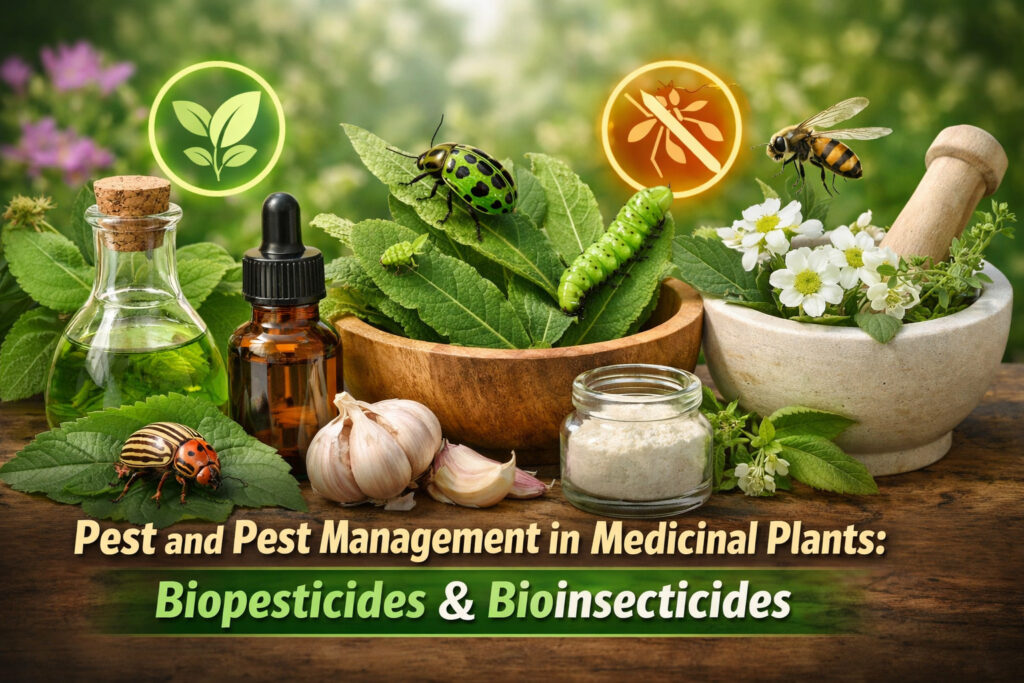
Nature and Impact of Pests in Medicinal Plants
A pest is any organism that interferes with plant growth, development, or productivity. In medicinal plants, pest damage is more critical than in conventional crops because it may reduce or modify the concentration of active constituents such as alkaloids, glycosides, and essential oils.
Pest infestation can occur at different stages of plant growth, from seedling to maturity, and even during storage. The damage caused is often both direct and indirect. Direct damage includes feeding on plant tissues, while indirect damage involves transmission of diseases and secondary infections.
Medicinal plants are affected by a diverse group of pests, including insects, mites, nematodes, fungi, bacteria, and weeds. Among these, insect pests are the most common and destructive.
Major pest groups include:
- Chewing insects (caterpillars, beetles) that destroy leaves and stems
- Sucking insects (aphids, whiteflies) that reduce plant vitality
- Soil pests (nematodes, grubs) affecting root systems
- Pathogens causing leaf spots, wilting, and rot
The presence of pests not only reduces biomass but can also lead to contamination with microbial toxins, making the herbal material unsuitable for medicinal use.
Concept of Pest Management in Medicinal Plants
Pest management in medicinal plants is not merely about eliminating pests but about maintaining pest populations below harmful levels while ensuring product safety and environmental protection.
Unlike conventional agriculture, where chemical pesticides are widely used, medicinal plant cultivation emphasizes minimum chemical intervention. This is because pesticide residues can persist in plant materials and pose health risks.
The modern approach to pest control is based on Integrated Pest Management (IPM), which combines multiple strategies to achieve effective and sustainable control.
Integrated Pest Management (IPM)
Integrated Pest Management is a comprehensive approach that integrates biological, cultural, mechanical, and chemical methods in a coordinated manner.
The fundamental principle of IPM is prevention rather than cure, along with continuous monitoring of pest populations.
Core Components of IPM:
IPM operates through a combination of strategies such as:
- Cultural practices that create unfavorable conditions for pests
- Biological control using natural enemies
- Mechanical removal of pests
- Judicious use of safe pesticides only when necessary
This approach reduces dependence on synthetic chemicals and helps maintain ecological balance.
Biopesticides and Bioinsecticides
Biopesticides are natural agents derived from living organisms or natural products used to control pests. When specifically targeting insects, they are referred to as bioinsecticides.
These agents are gaining importance in medicinal plant cultivation due to their low toxicity, biodegradability, and specificity.
Biopesticides act through various mechanisms such as infection, toxicity, repellence, or disruption of pest life cycles.
Classification and Mechanism of Biopesticides
Biopesticides can be classified based on their origin and mode of action. Each type plays a unique role in pest management.
Microbial Biopesticides
Microbial biopesticides consist of microorganisms such as bacteria, fungi, viruses, or protozoa that infect and kill pests.
A classic example is Bacillus thuringiensis, which produces crystalline toxins that disrupt the digestive system of insect larvae, leading to their death.
Fungal agents like Trichoderma are also widely used to control soil-borne pathogens.
These agents are highly specific and generally do not affect non-target organisms.
Botanical Biopesticides
Botanical biopesticides are derived from plants with natural pesticidal properties. These plants produce secondary metabolites that act as insect repellents, antifeedants, or toxins.
The most prominent example is neem, obtained from Azadirachta indica. Neem contains azadirachtin, which interferes with insect growth and reproduction.
Other botanical sources include pyrethrum, nicotine, and rotenone, each having specific insecticidal properties.
Biochemical Biopesticides
Biochemical biopesticides include naturally occurring substances that control pests through non-toxic mechanisms.
These include pheromones used to attract insects into traps, thereby disrupting mating and reducing pest populations. Growth regulators that interfere with insect development also fall under this category.
Application of Biopesticides in Medicinal Plants
The application of biopesticides requires careful consideration of timing, dosage, and environmental conditions. Unlike chemical pesticides, biopesticides are often more effective when applied during specific stages of the pest life cycle.
In medicinal plants, they are commonly used in:
- Field cultivation to control insect pests
- Soil treatment to manage pathogens
- Storage protection to prevent infestation
Their use ensures that herbal materials remain free from harmful residues, which is essential for pharmaceutical applications
Advantages of Biopesticides in Medicinal Plant Cultivation
Biopesticides offer several advantages that make them ideal for use in medicinal plants.
- They are biodegradable and environmentally safe
- They leave minimal or no toxic residues
- They are target-specific and do not harm beneficial organisms
- They support organic and sustainable farming systems
- They help maintain phytochemical integrit
Limitations and Challenges
Despite their benefits, biopesticides are not without limitations. Their effectiveness can be influenced by environmental conditions such as temperature, humidity, and sunlight. They generally act more slowly than chemical pesticides and may require repeated applications.
Another challenge is the lack of awareness and availability among farmers, as well as the need for proper storage and handling to maintain their activity.
Role in Sustainable and Quality-Oriented Herbal Production
Biopesticides play a crucial role in ensuring that medicinal plants meet international quality standards. Their use aligns with guidelines such as
They also contribute to:
- Environmental conservation
- Reduction of chemical pollution
- Long-term soil health
- Improved global acceptance of herbal products
Future Trends in Biopesticide Development
Advancements in biotechnology are leading to the development of more effective and stable biopesticide formulations. Research is focused on improving their shelf-life, enhancing their efficacy, and combining multiple agents for synergistic effects.
Emerging areas include:
- Nano-formulated biopesticides
- Genetically engineered microbial agents
- Integration with precision agriculture
Conclusion
Pest management in medicinal plants is a critical component of producing high-quality herbal raw materials. The use of biopesticides and bioinsecticides offers a safe, effective, and environmentally sustainable approach to pest control. By integrating these biological methods with modern agricultural practices, it is possible to protect crops while preserving their medicinal value and ensuring compliance with global quality standards.