Indian Systems of Medicine: India possesses a vast and diverse heritage of traditional systems of medicine that have evolved over centuries through observation, experience, and philosophical understanding of life and nature. These systems are fundamentally different from modern allopathic medicine, as they emphasize a holistic approach, focusing on the balance between body, mind, spirit, and environment.
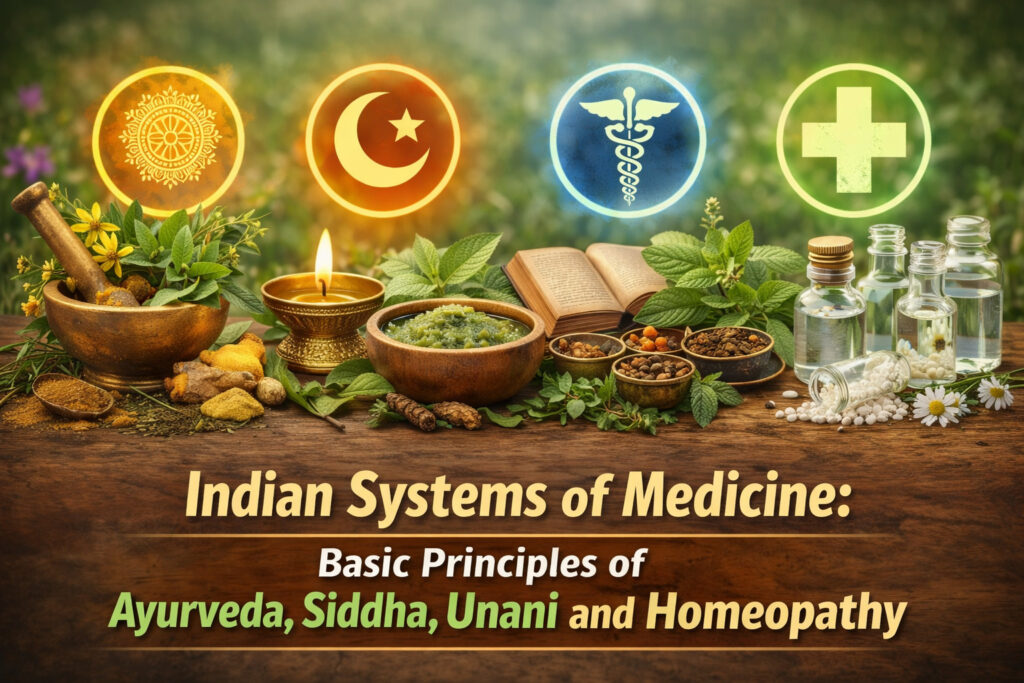
The major systems include Ayurveda, Siddha, Unani, and Homeopathy, each having its own theoretical framework, diagnostic methods, and therapeutic approaches. Despite their differences, all these systems aim to restore the natural equilibrium of the body, which is considered essential for maintaining health and preventing disease.
Indian Systems of Medicine
Ayurveda
Ayurveda is the oldest and most widely practiced traditional system of medicine in India. It is believed to have originated from ancient Vedic knowledge and is documented in classical texts such as Charaka Samhita and Sushruta Samhita.
The fundamental philosophy of Ayurveda is that health is a state of complete balance between the body, mind, and consciousness, and disease occurs when this balance is disturbed.
Core Concepts of Ayurveda
The central principle of Ayurveda is the Tridosha theory, which explains physiological and pathological processes in the body.
- Vata governs movement, nervous functions, respiration, and circulation
- Pitta controls digestion, metabolism, and biochemical transformations
- Kapha provides structural integrity, lubrication, and stability
Each individual has a unique combination of these doshas, known as Prakriti (body constitution), which determines susceptibility to diseases.
Another fundamental concept is the Panchamahabhuta theory, which states that all living and non-living matter is composed of five elements:
- Earth (Prithvi)
- Water (Jala)
- Fire (Agni)
- Air (Vayu)
- Ether (Akasha)
These elements combine to form the doshas and influence body structure and function.
Functional Components of the Body
Ayurveda describes the body in terms of:
- Sapta Dhatus (seven tissues) such as plasma, blood, muscle, fat, bone, marrow, and reproductive tissue
- Malas (waste products) including urine, feces, and sweat
- Agni (digestive fire), which is responsible for metabolism and transformation of food into energy
A disturbance in any of these components leads to disease.
Diagnostic and Therapeutic Approach
Diagnosis in Ayurveda involves understanding the imbalance of doshas through examination of pulse, tongue, eyes, and overall constitution.
Treatment aims at restoring balance through:
- Herbal formulations
- Dietary regulation
- Lifestyle modification
- Detoxification therapies such as Panchakarma
Ayurveda places strong emphasis on preventive healthcare, including daily and seasonal regimens.
Siddha System
The Siddha system is one of the oldest medical systems practiced predominantly in South India. It is closely associated with Tamil culture and is believed to have been developed by enlightened sages called Siddhars.
The Siddha system integrates spiritual, physical, and alchemical principles, aiming not only to cure disease but also to attain longevity and immortality.
Fundamental Principles of Siddha
Siddha medicine is based on the concept of three humors, similar to Ayurveda:
- Vali (air) – responsible for movement and nerve functions
- Azhal (fire) – responsible for metabolism and heat
- Iyyam (water and earth) – responsible for structure and lubrication
Health is maintained when these humors are balanced.
The system also follows the five-element theory, where the human body is composed of earth, water, fire, air, and ether.
Unique Features of Siddha
Siddha differs from Ayurveda in its extensive use of minerals, metals, and herbo-mineral preparations, which are processed through special purification techniques.
It also emphasizes:
- Kayakalpa therapy, aimed at rejuvenation and delaying aging
- The concept of 96 tattvas, which describe physical, physiological, and psychological aspects of human existence
Therapeutic Approach
Treatment in Siddha includes:
- Herbal medicines
- Mineral-based drugs
- Dietary regulation
- Yogic and lifestyle practices
The system aims at achieving perfect harmony between body and soul.
Unani System of Medicine
The Unani system has its roots in ancient Greek medicine and was later enriched by Arab and Persian scholars before being introduced to India. It is based on the teachings of Hippocrates and further developed by Galen.
Unani medicine is founded on the belief that the body has a natural ability to heal itself, known as Tabiyat (vital force).
Basic Principles of Unani
The central concept of Unani medicine is the Humoral Theory, which states that the human body contains four humors:
- Blood (Dam) – hot and moist
- Phlegm (Balgham) – cold and moist
- Yellow bile (Safra) – hot and dry
- Black bile (Sauda) – cold and dry
The balance of these humors determines health, while imbalance leads to disease.
Concept of Temperament (Mizaj)
Each individual has a specific temperament (Mizaj), which influences physical and mental characteristics as well as disease susceptibility.
Treatment is personalized based on the patient’s temperament.
Six Essential Factors (Asbab-e-Sitta Zarooriya)
Unani medicine identifies six essential factors necessary for maintaining health:
- Air (environment)
- Food and drink
- Physical activity and rest
- Sleep and wakefulness
- Excretion and retention
- Mental state
Therapeutic Methods
Unani treatment is based on three main approaches:
- Regimental therapy (e.g., massage, cupping, exercise)
- Diet therapy
- Pharmacotherapy using herbal, mineral, and animal products
Homeopathy
Homeopathy is a system of medicine developed in the 18th century by Samuel Hahnemann. It is based on a completely different philosophy compared to other systems and is widely practiced in India.
Fundamental Principles of Homeopathy
The central principle of homeopathy is the Law of Similars, which states that:
A substance that produces symptoms in a healthy individual can be used to treat similar symptoms in a diseased individual.
Key Concepts
- Minimum dose: Medicines are administered in extremely small doses
- Potentization: Serial dilution and shaking enhance the medicinal power
- Individualization: Treatment is based on the patient’s total symptom profile, not just the disease
Vital Force Concept
Homeopathy believes in the presence of a vital force that maintains health. Disease is considered a disturbance of this force, and treatment aims to stimulate its self-healing capacity.
Therapeutic Approach
Homeopathic treatment involves:
- Detailed case-taking (physical, mental, emotional symptoms)
- Selection of a single, appropriate remedy
- Use of highly diluted preparations
Comparative Insight
Although Ayurveda, Siddha, Unani, and Homeopathy differ in their origins and methodologies, they share certain fundamental similarities.
All these systems:
- Emphasize holistic treatment
- Focus on restoring internal balance
- Prefer natural remedies
- Consider individual differences in treatment
At the same time, their approaches vary significantly:
- Ayurveda and Siddha are based on elemental and dosha theories
- Unani focuses on humoral balance and temperament
- Homeopathy is based on symptom similarity and vital force
Modern Relevance and Integration
In the present era, these traditional systems are gaining global recognition due to their safety, holistic approach, and minimal side effects. Governments and health organizations are promoting their integration with modern medicine.
Research is being conducted to:
- Validate traditional formulations scientifically
- Standardize herbal medicines
- Develop evidence-based practices
Conclusion
The Indian systems of medicine, including Ayurveda, Siddha, Unani, and Homeopathy, represent a rich blend of traditional wisdom and holistic healthcare principles. Their emphasis on balance, prevention, and individualized treatment makes them highly relevant even in modern times. With increasing scientific validation and global acceptance, these systems continue to contribute significantly to healthcare and pharmaceutical sciences.