
Aim: Effect of Saline Purgative on Frog Intestine
1. Objective
To study the effect of a saline purgative (e.g., magnesium sulfate or sodium sulfate) on the movements (motility and tone) of the isolated frog intestine preparation, and to understand its mechanism of action as a purgative agent.
2. Principle
Saline purgatives are osmotic agents that retain water in the intestinal lumen by increasing osmotic pressure, leading to distention of the intestine and enhanced peristaltic movement.
In this experiment, the isolated frog intestine is mounted in an organ bath, and the contraction responses are recorded before and after the addition of a saline purgative solution.
The increase in tone and amplitude of contractions indicates the stimulant action of the purgative on the smooth muscle of the intestine.
3. Requirements
Animals: Frog (Rana tigrina) – either sex, medium size.
Chemicals & Solutions:
- Ringer’s solution (Frog Ringer’s solution)
- Magnesium sulfate (MgSO₄) or sodium sulfate (Na₂SO₄) – as saline purgative
- Distilled water
- Normal saline
- Oxygen supply
Apparatus:
- Student kymograph or physiograph
- Organ bath (capacity 25–30 mL)
- Aeration tube
- Frog dissecting instruments (scissors, forceps, thread, etc.)
- Thread and tissue clips
- Thermometer
- Writing lever (heart lever)
- Time marker
4. Composition of Frog Ringer’s Solution
| Component | Concentration (g/L) | Purpose |
| NaCl | 6.5 | Maintains osmotic balance |
| KCl | 0.14 | Maintains membrane potential |
| CaCl₂ | 0.12 | Muscle contraction |
| NaHCO₃ | 0.2 | Buffering agent |
| Glucose | 2.0 | Energy source |
| pH: 7.2–7.4 |
5. Experimental Procedure
A. Preparation of Frog Intestine
- Pith the frog (destroy the brain and spinal cord humanely).
- Open the abdomen through a midline incision.
- Identify and isolate a portion of the small intestine (duodenum or ileum).
- Cut a segment (about 3–4 cm long) and flush it gently with Ringer’s solution to remove contents.
B. Mounting the Tissue
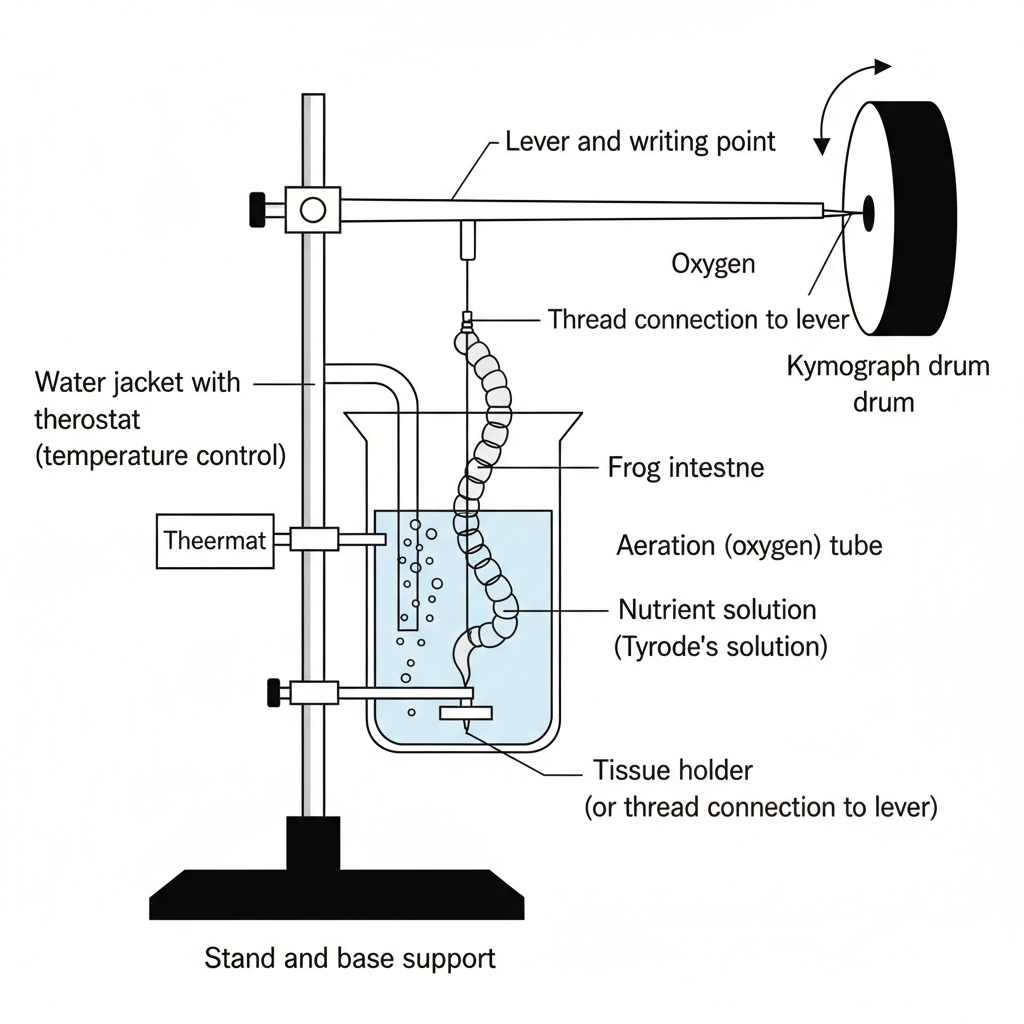
- Mount the intestine in an organ bath containing frog Ringer’s solution maintained at room temperature (~25°C).
- Aerate the bath continuously with oxygen.
- One end of the intestine is tied to a tissue holder (fixed hook) and the other to a writing lever connected to a kymograph drum or physiograph.
- Maintain a resting tension of 0.5–1.0 g on the tissue.
- Allow the tissue to equilibrate for 10–15 minutes, during which spontaneous rhythmic contractions will appear.
C. Recording the Response
- Record the normal spontaneous contractions of the frog intestine (control).
- Add a measured amount of magnesium sulfate or sodium sulfate solution to the organ bath. Concentration: 0.5% to 1% w/v (saline purgative).
- Record the contractions for another 5–10 minutes.
- Wash the tissue with fresh Ringer’s solution and observe recovery.
D. Observation
Note changes in amplitude, frequency, and tone of contractions after adding the saline purgative.
6. Results
| Treatment | Amplitude of Contraction | Tone of Muscle | Observation |
| Control (Ringer’s only) | Normal rhythmic contractions | Normal | Baseline intestinal motility |
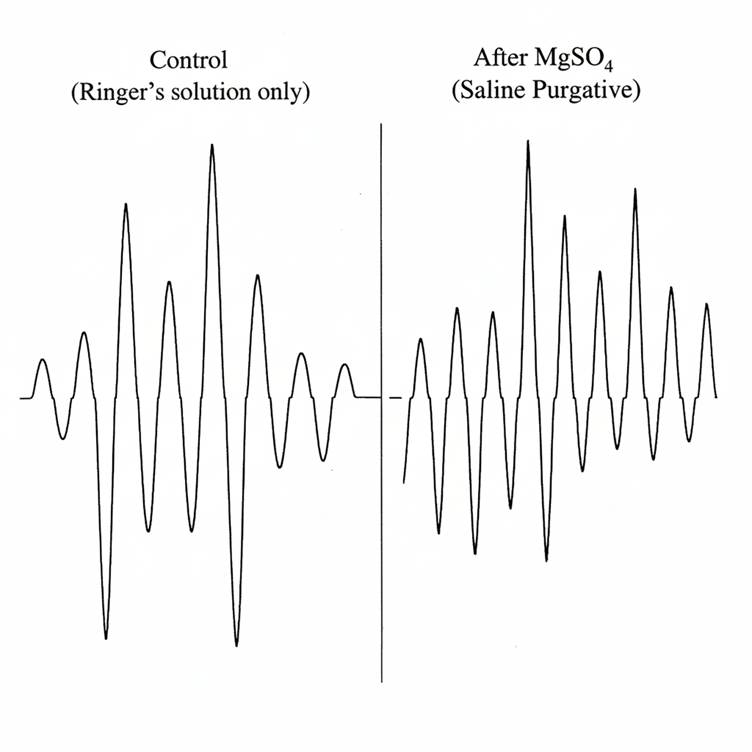
| After MgSO₄ (saline purgative) | Increased | Increased | Enhanced peristaltic activity |
Graphical Recording:
- The kymograph tracing will show an increase in the height of contractions after the addition of saline purgative, indicating stimulation of intestinal smooth muscles.
7. Discussion
Saline purgatives such as magnesium sulfate act mainly by osmotic mechanisms:
- They are poorly absorbed from the intestine.
- They retain water in the intestinal lumen by increasing osmotic pressure.
- This dilutes intestinal contents and distends the intestinal wall.
- The stretch of smooth muscle activates myenteric reflexes, resulting in enhanced peristalsis.
In the isolated frog intestine, the saline purgative directly increases the tone and amplitude of contractions, simulating the mechanical distension that occurs in vivo.
Hence, the experiment demonstrates that saline purgatives stimulate intestinal motility by osmotic and local mechanical effects on smooth muscle.
8. Precautions
- The frog should be pithed humanely as per CPCSEA guidelines.
- Maintain constant temperature and pH of Ringer’s solution.
- Avoid air bubbles in the tissue mounting thread.
- Wash the tissue after each addition of drug to avoid fatigue.
- Do not use high concentrations of saline purgative; it may damage tissue.
- Ensure proper aeration during the experiment.
9. Conclusion
Saline purgatives (e.g., magnesium sulfate) increase intestinal motility by enhancing peristaltic movements and increasing muscle tone, which facilitates the expulsion of intestinal contents.
This demonstrates the pharmacodynamic effect of purgatives on intestinal smooth muscle.
10. References
- Kulkarni, S.K., Handbook of Experimental Pharmacology, 4th Edition, Vallabh Prakashan, 2012.
- Ghosh, M.N., Fundamentals of Experimental Pharmacology, 7th Edition, Hilton & Company, 2016.
- Indian Pharmacopoeia (IP), Government of India, 2020.
- K.D. Tripathi, Essentials of Medical Pharmacology, 9th Edition, Jaypee Brothers Medical Publishers, 2023.
- Rang, Dale and Ritter, Pharmacology, 9th Edition, Elsevier, 2022.