

E–Z nomenclature is a system used to describe geometrical isomers of alkenes when the simple cis–trans system cannot be applied. It is based on the Cahn–Ingold–Prelog (CIP) priority rules.
The letters E and Z are derived from German words:
- E (Entgegen) → means opposite
- Z (Zusammen) → means together
This system is used when the double-bonded carbon atoms have different substituent groups, making cis–trans naming insufficient.
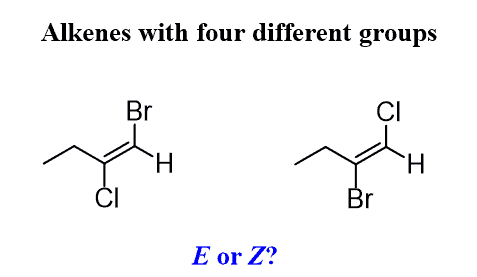
Why E–Z Nomenclature is Needed
The cis–trans system works only when identical groups are present on the double-bonded carbon atoms.
Example where cis–trans cannot be used:
CHCl = CBrF
Here each carbon has two different substituents, so it is difficult to decide which groups should be compared for cis or trans.
Therefore, the E–Z system is used.
Cahn–Ingold–Prelog Priority Rules
To assign E or Z configuration, priorities must be assigned to substituent groups attached to each carbon of the double bond.
Rule 1: Atomic Number
The atom with the higher atomic number gets higher priority.
Example priority order:
I > Br > Cl > S > O > N > C > H
Thus:
- Br has higher priority than Cl
- Cl has higher priority than C
- C has higher priority than H
Rule 2: If Atoms Are the Same
If the directly attached atoms are identical, compare the next atoms along the chain until a difference is found.
Example:
CH₃ vs CH₂CH₃
The ethyl group (CH₂CH₃) has higher priority than the methyl group (CH₃).
Rule 3: Multiple Bonds
Multiple bonds are treated as if the atom is bonded to equivalent multiple atoms.
Example:
- C=O is treated as C bonded to two oxygen atoms.
Steps to Assign E–Z Configuration
Step 1: Identify the Double Bond
Locate the C=C double bond in the molecule.
Step 2: Assign Priority to Substituents
Determine the priority of substituents attached to each carbon based on atomic number.
Step 3: Compare Highest Priority Groups
Observe the positions of the two highest priority groups.
Step 4: Assign Configuration
Z Configuration
If the highest priority groups are on the same side, the compound is Z.
Z = Zusammen (together)
Example:
CH₃ CH₃
\ /
C = C
/ \
H H
Here the higher priority groups are together.
Name: Z-but-2-ene
E Configuration
If the highest priority groups are on opposite sides, the compound is E.
E = Entgegen (opposite)
Example:
CH₃ H
\ /
C = C
/ \
H CH₃
The higher priority groups are opposite.
Name: E-but-2-ene
Example of E–Z Nomenclature
Example Molecule
1-bromo-1-chloro-2-fluoro-2-iodoethene
Step 1: Identify substituents.
Carbon 1:
- Br
- Cl
Carbon 2:
- I
- F
Step 2: Assign priorities.
Carbon 1:
Br (higher priority) > Cl
Carbon 2:
I (higher priority) > F
Step 3: Compare positions of Br and I.
- Same side → Z isomer
- Opposite side → E isomer
Differences Between E–Z and Cis–Trans Nomenclature
| Feature | Cis–Trans System | E–Z System |
| Basis | Same or opposite position of identical groups | Priority rules |
| Applicability | Simple molecules | Complex molecules |
| Accuracy | Limited | More accurate |
| Rule system | Simple comparison | Cahn–Ingold–Prelog rules |
Importance of E–Z Nomenclature
E–Z nomenclature is important because:
- It provides accurate naming for complex alkenes.
- It is internationally accepted (IUPAC system).
- It helps chemists understand the exact spatial arrangement of atoms.
- It is widely used in pharmaceutical and medicinal chemistry.
Different geometrical isomers may have different biological or pharmacological activities, so correct identification is essential.
Summary
E–Z nomenclature is an IUPAC system used to describe geometrical isomers of alkenes when cis–trans naming is insufficient. It is based on the Cahn–Ingold–Prelog priority rules, which assign priorities to substituent groups based on atomic number.
- If the highest priority groups are on the same side, the compound is Z (Zusammen).
- If the highest priority groups are on opposite sides, the compound is E (Entgegen).
This system allows accurate identification of complex geometrical isomers, which is particularly important in organic and pharmaceutical chemistry.