
Definition
Anti-platelet drugs, also known as platelet aggregation inhibitors, are pharmacological agents that interfere with platelet activation and aggregation—key processes in the formation of blood clots (thrombi). Unlike anticoagulants, which act on the coagulation cascade, anti-platelet agents primarily act by inhibiting platelet adhesion, activation, and aggregation, thereby reducing the risk of arterial thrombotic events such as myocardial infarction (MI), stroke, and peripheral arterial disease.
Platelet activation plays a central role in arterial thrombosis, especially under high shear conditions, making anti-platelet therapy a cornerstone in the prevention and management of cardiovascular and cerebrovascular diseases.
Classification of Anti-Platelet Drugs
Anti-platelet drugs can be broadly classified based on their mechanism of action into the following categories:
1. Cyclooxygenase Inhibitors (COX Inhibitors)
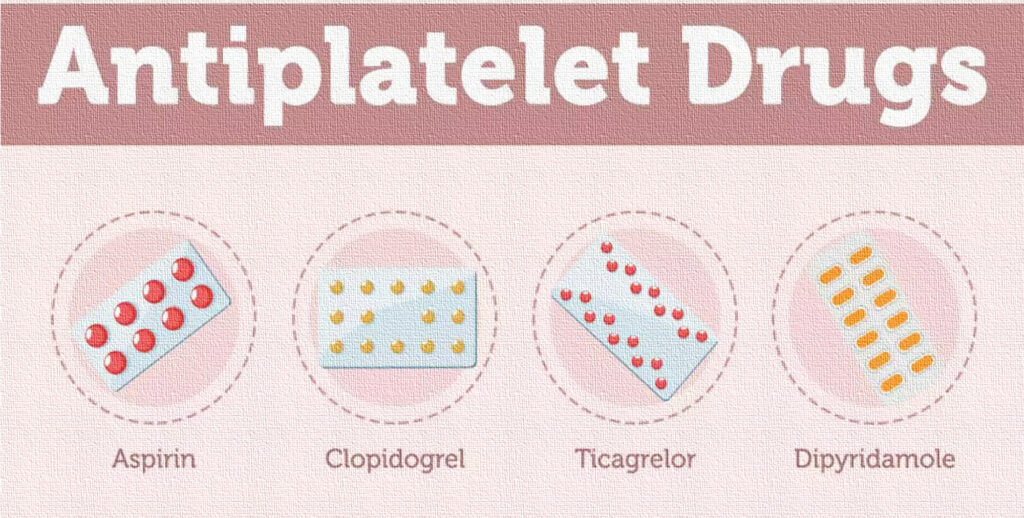
- Example: Aspirin (Acetylsalicylic acid)
- Mechanism: Irreversibly inhibits cyclooxygenase-1 (COX-1) in platelets, preventing the formation of thromboxane A₂ (TXA₂), a potent vasoconstrictor and platelet aggregator.
2. ADP Receptor Inhibitors (P2Y12 Receptor Antagonists)
These agents inhibit the binding of adenosine diphosphate (ADP) to its platelet receptor (P2Y12), thereby inhibiting ADP-mediated platelet activation and aggregation.
Irreversible P2Y12 inhibitors:
- Clopidogrel
- Prasugrel
- Ticlopidine
Reversible P2Y12 inhibitors:
- Ticagrelor
- Cangrelor (IV formulation for short-term use)
3. Glycoprotein IIb/IIIa Receptor Antagonists
These drugs block the final common pathway of platelet aggregation by inhibiting the glycoprotein IIb/IIIa receptor on activated platelets, which normally binds fibrinogen and von Willebrand factor (vWF), facilitating platelet cross-linking.
Examples:
- Abciximab (monoclonal antibody)
- Eptifibatide (cyclic heptapeptide)
- Tirofiban (non-peptide antagonist)
4. Phosphodiesterase (PDE) Inhibitors
These drugs increase intracellular levels of cyclic AMP (cAMP) and/or cyclic GMP (cGMP) in platelets, leading to inhibition of platelet aggregation.
Examples:
- Dipyridamole (PDE3 inhibitor; also inhibits adenosine uptake)
- Cilostazol (PDE3 inhibitor with vasodilatory properties)
5. Protease-Activated Receptor-1 (PAR-1) Antagonists
These agents block thrombin-induced platelet activation by selectively antagonizing the PAR-1 receptor.
Example: Vorapaxar
6. Other Novel and Experimental Agents
Thromboxane Receptor Antagonists: E.g., Terutroban
Thromboxane Synthase Inhibitors: E.g., Ozagrel
ADP Degrading Enzymes: E.g., Apyrase (experimental)
Mechanism of Action
Each class of anti-platelet drugs targets specific molecular pathways involved in platelet activation and aggregation:
1. Aspirin (COX Inhibitor)
Aspirin irreversibly acetylates a serine residue in the active site of COX-1, permanently inhibiting the enzyme in platelets (which lack nuclei and cannot resynthesize COX-1). This inhibits the synthesis of thromboxane A₂ (TXA₂), a key promoter of platelet aggregation and vasoconstriction. Low doses (75–150 mg/day) selectively inhibit platelet COX-1 while sparing endothelial COX-2, which produces prostacyclin (PGI₂), a platelet aggregation inhibitor and vasodilator.
2. P2Y12 Receptor Antagonists
Platelets have ADP receptors (P2Y1 and P2Y12). Binding of ADP to P2Y12 activates G-protein coupled pathways that lower cAMP, promoting aggregation. Clopidogrel and Prasugrel are prodrugs requiring hepatic activation via cytochrome P450 enzymes. Ticagrelor, a reversible inhibitor, does not require metabolic activation and provides faster, more consistent inhibition of P2Y12.
3. GP IIb/IIIa Receptor Antagonists
The GP IIb/IIIa receptor is the final common pathway for platelet aggregation, binding to fibrinogen and vWF. Blocking this receptor inhibits the cross-linking of platelets, which is essential for thrombus formation. These agents are typically used intravenously in acute coronary syndromes or during PCI.
4. PDE Inhibitors
Dipyridamole and Cilostazol increase cAMP (and cGMP in case of dipyridamole), which in turn inhibits the release of granules containing pro-aggregatory substances from platelets. These agents also cause vasodilation, which can be beneficial in peripheral arterial disease.
5. PAR-1 Antagonists (e.g., Vorapaxar)
Thrombin, the most potent platelet activator, acts via PAR-1 and PAR-4 receptors. Vorapaxar selectively and reversibly inhibits PAR-1, reducing thrombin-induced platelet aggregation.
Therapeutic Uses of Anti-Platelet Drugs
Anti-platelet drugs are widely used in both primary and secondary prevention of thromboembolic events, particularly in arterial circulation, where platelet-rich “white thrombi” dominate.
Major Clinical Indications:
1. Cardiovascular Diseases
- Acute coronary syndrome (ACS) – includes unstable angina, NSTEMI, STEMI
- Post-percutaneous coronary intervention (PCI) with stent placement – dual anti-platelet therapy (DAPT) with aspirin + P2Y12 inhibitor
- Post-coronary artery bypass grafting (CABG)
- Secondary prevention after myocardial infarction
2. Cerebrovascular Diseases
- Transient ischemic attack (TIA)
- Ischemic stroke – especially non-cardioembolic
- Stroke prevention in atrial fibrillation (limited role unless anticoagulants are contraindicated)
3. Peripheral Arterial Disease (PAD)
- Used to reduce risk of cardiovascular events and improve limb perfusion
4. Vascular Interventions
- After carotid endarterectomy or stenting
- Hemodialysis shunt thrombosis prevention
5. Others
- Prevention of thromboembolism in atrial fibrillation (in select cases)
- Buerger’s disease and Raynaud’s phenomenon (cilostazol use)
- Prevention of graft occlusion in vascular surgery
Adverse Drug Reactions (ADRs)
Although anti-platelet drugs offer substantial benefits in reducing thrombotic events, they are not without adverse effects, primarily related to bleeding risk. The ADRs vary with the class of drugs and the individual pharmacodynamic profile.
Common and Notable ADRs:
1. Aspirin
- Gastrointestinal bleeding and ulceration (due to COX-1 inhibition in gastric mucosa)
- Hypersensitivity reactions (bronchospasm, rash)
- Reye’s syndrome (in children with viral infections)
- Tinnitus and salicylism (at higher doses)
2. P2Y12 Inhibitors
- Clopidogrel:
- Bleeding (GI, intracranial)
- Rare: Thrombotic thrombocytopenic purpura (TTP)
- Genetic polymorphism of CYP2C19 may reduce efficacy
- Ticagrelor:
- Dyspnea
- Bradyarrhythmias
- Increased uric acid and serum creatinine
- Prasugrel:
- Higher bleeding risk than clopidogrel
- Contraindicated in patients with prior stroke or TIA
3. GP IIb/IIIa Inhibitors
- Thrombocytopenia (acute and profound)
- Bleeding complications
- Allergic reactions, especially with abciximab
4. PDE Inhibitors
- Dipyridamole:
- Headache
- Dizziness
- Hypotension
- Cilostazol:
- Palpitations
- Diarrhea
- Contraindicated in heart failure due to increased mortality risk
5. PAR-1 Antagonist (Vorapaxar)
- Bleeding, especially intracranial
- Not recommended in patients with history of stroke, TIA, or intracranial hemorrhage
Conclusion
Anti-platelet agents are a cornerstone in the prevention and management of atherothrombotic disorders, particularly in the context of arterial thrombosis. Understanding their mechanisms, classifications, and safety profiles is essential for optimizing cardiovascular care and minimizing risk. With the increasing sophistication of cardiovascular interventions, the role of combination anti-platelet therapy (e.g., DAPT) and the personalization of anti-platelet regimens based on genetic and clinical factors are gaining clinical relevance.