
Aim: Anti-inflammatory Activity of Drugs Using Carrageenan-Induced Paw Edema Model
References:
- Winter, C.A., Risley, E.A., & Nuss, G.W. (1962). Carrageenan-Induced Edema in Hind Paw of the Rat as an Assay for Anti-inflammatory Drugs. Proceedings of the Society for Experimental Biology and Medicine, 111(3), 544-547.
- Vogel, H.G. (2008). Drug Discovery and Evaluation: Pharmacological Assays. Springer.
Objective:
To evaluate the anti-inflammatory activity of a drug using the carrageenan-induced paw edema model in rats.
Materials Required:
1. Adult albino rats (150-200 g)
2. Carrageenan solution (1% in saline)
3. Anti-inflammatory drug (e.g., Indomethacin, Diclofenac)
4. Normal saline
5. Micrometer screw gauge (Vernier caliper) for paw measurement
6. Syringes and needles
7. Digital balance
8. Stopwatch
9. Lab notebook for recording data
Procedure:
1. Animal Preparation: Use adult albino rats weighing between 150-200 g.Acclimatize the rats to laboratory conditions for at least one week before the experiment.
2. Grouping of Animals: Divide the animals into at least three groups (6 rats per group):
1. Control Group: Receives only saline.
2. Carrageenan Group: Receives carrageenan injection to induce inflammation.
3. Test Group: Receives carrageenan injection and the anti-inflammatory drug (e.g., Indomethacin).
3. Induction of Paw Edema: Inject 0.1 mL of 1% carrageenan solution subcutaneously into the plantar surface of the right hind paw of each rat to induce inflammation.
4. Administration of Drug: Administer the anti-inflammatory drug (e.g., Indomethacin at 10 mg/kg) orally or intraperitoneally 30 minutes before carrageenan injection in the test group.The control group receives saline instead of the drug.
5. Measurement of Paw Edema: Measure the thickness of the rat’s paw using a micrometer screw gauge (Vernier caliper) immediately before carrageenan injection (0 hours) to obtain the baseline measurement.Measure paw thickness again at 1, 2, 3, and 4 hours after carrageenan injection.
6. Calculation of Edema Volume: Calculate the increase in paw thickness by subtracting the baseline paw measurement (at 0 hours) from the measurements taken at subsequent time points.
Calculate the percentage inhibition of edema using the formula:
Percentage Inhibition = × 100
Data Recording:
Sample Data Table:
| Time (hours) | Paw Thickness (Control, mm) | Paw Thickness (Carrageenan, mm) | Paw Thickness (Drug Treated, mm) |
| 0 | 2.0 | 2.0 | 2.0 |
| 1 | 2.5 | 3.5 | 2.8 |
| 2 | 2.7 | 4.0 | 3.0 |
| 3 | 2.8 | 4.2 | 3.2 |
| 4 | 2.8 | 4.3 | 3.1 |
Graphs:
1. Paw Edema Over Time: Plot paw thickness (in mm) on the Y-axis and time (in hours) on the X-axis for the control group, carrageenan group, and drug-treated group.
2. Percentage Inhibition of Edema: Calculate and plot the percentage inhibition of edema over time for the drug-treated group compared to the carrageenan group.
Sample Graphs:
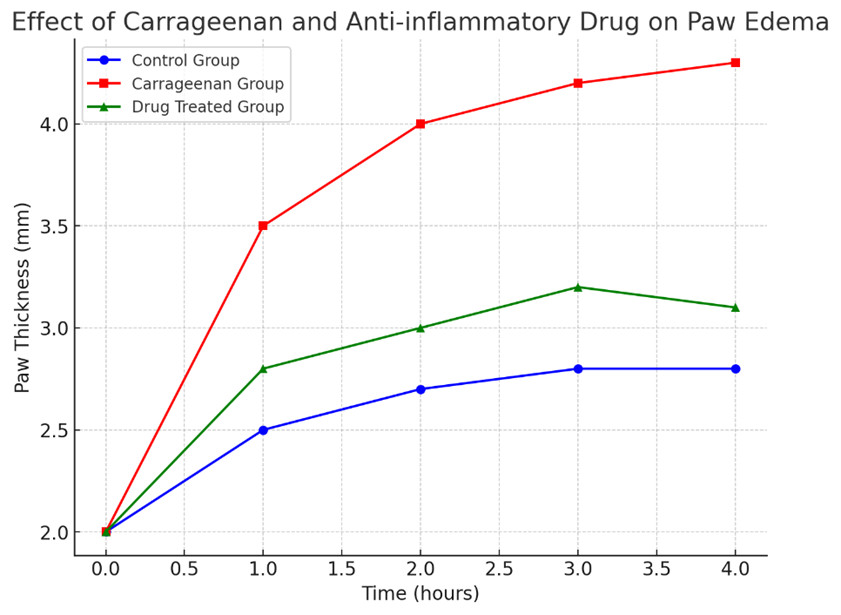
The graph showing the effect of carrageenan and the anti-inflammatory drug on paw edema in rats over time. The control group (blue) shows minimal change, while the carrageenan group (red) exhibits significant edema. The drug-treated group (green) shows reduced paw thickness, indicating anti-inflammatory activity.