
The cerebellum, often referred to as the “little brain,” is a crucial component of the central nervous system (CNS) situated posteriorly in the cranial cavity, beneath the occipital lobes of the cerebrum and behind the brainstem. Although it constitutes only about 10% of the brain’s total volume, it contains more than 50% of all neurons, reflecting its highly complex neural architecture and immense processing power.
The cerebellum plays a fundamental role in coordination, balance, muscle tone, posture, and motor learning. It ensures that body movements are smooth, precise, and coordinated.
I. Anatomy of the Cerebellum
A. Location and General Features
The cerebellum is located in the posterior cranial fossa, separated from the cerebrum by a fold of dura mater known as the tentorium cerebelli. It lies dorsal to the pons and medulla oblongata, forming the roof of the fourth ventricle.
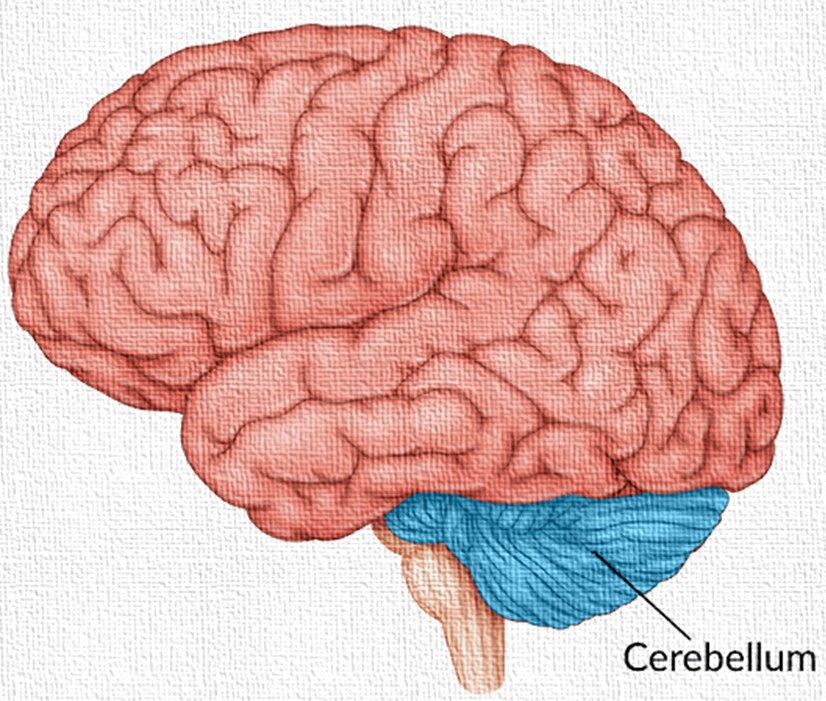
Structurally, it consists of two hemispheres connected by a narrow, worm-like structure called the vermis. The surface of the cerebellum is highly folded into transverse convolutions, called folia, which increase its surface area for neural processing.
B. Divisions of the Cerebellum
The cerebellum can be divided based on anatomical, phylogenetic, and functional criteria:
- Anatomical Division:
- Vermis: The central midline structure that connects the two hemispheres and coordinates movements of the trunk and proximal limbs.
- Cerebellar Hemispheres: Each hemisphere is divided into medial and lateral parts; the lateral hemispheres are involved in fine motor coordination of the distal limbs.
- Phylogenetic Division (Evolutionary Basis):
- Archicerebellum (Vestibulocerebellum): The oldest part; includes the flocculonodular lobe. It is primarily associated with balance and eye movement.
- Paleocerebellum (Spinocerebellum): Includes the vermis and intermediate zones; it regulates muscle tone and postural control.
- Neocerebellum (Cerebrocerebellum): The most developed part, consisting of the lateral hemispheres; it coordinates voluntary movements and is involved in motor learning and planning.
- Functional Division:
- Vestibulocerebellum: Maintains balance and controls eye movements.
- Spinocerebellum: Coordinates movements of the trunk and limbs.
- Cerebrocerebellum: Controls planning and timing of complex movements.
C. Lobes of the Cerebellum
The cerebellum is divided by deep fissures into three lobes:
- Anterior Lobe: Receives input from the spinal cord and regulates posture and limb movement.
- Posterior Lobe: Largest lobe; plays a significant role in fine motor coordination and voluntary motor control.
- Flocculonodular Lobe: Smallest lobe; primarily involved in balance and eye movement coordination.
D. Cerebellar Cortex and Internal Structure
The cerebellar cortex is the outer layer of gray matter, while the white matter lies beneath it. Embedded within the white matter are four pairs of deep cerebellar nuclei, which serve as the main output centers of the cerebellum.
1. Layers of the Cerebellar Cortex
The cortex consists of three distinct layers:
- Molecular Layer (Outer Layer): Contains axons of granule cells and dendrites of Purkinje cells; it facilitates synaptic interactions.
- Purkinje Cell Layer (Middle Layer): Contains large, flask-shaped Purkinje cells, which are the principal output neurons of the cerebellar cortex. These cells send inhibitory signals to the deep cerebellar nuclei.
- Granular Layer (Inner Layer): Composed of densely packed granule cells and interneurons; it receives excitatory input from mossy fibers.
2. White Matter and Deep Nuclei
- The white matter forms the central core and contains afferent (incoming) and efferent (outgoing) fibers.
- The deep cerebellar nuclei are:
- Dentate nucleus – largest, associated with planning and initiation of voluntary movements.
- Emboliform nucleus – regulates limb movements.
- Globose nucleus – coordinates muscle tone and posture.
- Fastigial nucleus – maintains equilibrium and balance.
E. Cerebellar Peduncles
The cerebellum communicates with the rest of the central nervous system through three pairs of cerebellar peduncles, which are bundles of nerve fibers:
- Superior Cerebellar Peduncle: Connects cerebellum to the midbrain; mainly carries efferent fibers.
- Middle Cerebellar Peduncle: Connects cerebellum to the pons; carries afferent fibers from the cerebral cortex via pontine nuclei.
- Inferior Cerebellar Peduncle: Connects cerebellum to the medulla oblongata and spinal cord; transmits sensory information related to balance and proprioception.
II. Physiology of the Cerebellum
The physiological role of the cerebellum centers on the coordination and regulation of motor activity, ensuring precision, timing, and balance in all voluntary movements. Although the cerebellum does not initiate movement, it fine-tunes and optimizes motor actions initiated by the cerebral cortex.
A. Functions of the Cerebellum
- Coordination of Voluntary Movements: The cerebellum ensures that muscle contractions occur in the proper sequence and with the correct force, producing smooth, coordinated movements rather than jerky or uncoordinated ones.
- Maintenance of Balance and Equilibrium: Through the vestibulocerebellum, it receives input from the vestibular apparatus of the inner ear, allowing the body to maintain equilibrium and adjust posture during movement.
- Regulation of Muscle Tone: The cerebellum influences the activity of motor neurons via descending pathways to maintain optimal muscle tone necessary for posture and smooth movement.
- Motor Learning and Adaptation: The cerebellum plays a vital role in motor learning — the process of acquiring new motor skills through practice, such as playing a musical instrument or riding a bicycle. It compares intended movement with actual performance and makes real-time corrections.
- Cognitive and Emotional Functions (Recent Findings): Modern neuroimaging studies have shown cerebellar involvement in cognitive processing, language, attention, and even emotional regulation, revealing its broader influence beyond motor control.
B. Mechanism of Cerebellar Control
The cerebellum operates as a comparator and coordinator:
- It receives afferent input from the proprioceptive system, vestibular apparatus, and motor cortex.
- It then compares the intended motor command with actual movement feedback.
- If discrepancies are detected, corrective signals are sent to motor centers to adjust muscle activity in real time.
III. Clinical Correlations
Damage or dysfunction of the cerebellum results in a group of disorders collectively known as cerebellar syndromes, which manifest as impaired coordination and balance.
Common Cerebellar Disorders:
- Ataxia: Loss of coordination of voluntary movements; walking becomes unsteady and staggering.
- Dysmetria: Inability to control the range of movement — overshooting or undershooting a target.
- Dysdiadochokinesia: Inability to perform rapid alternating movements smoothly.
- Intention Tremor: Tremor occurring during voluntary movement, intensifying as the target is approached.
- Hypotonia: Decreased muscle tone due to impaired cerebellar modulation.
- Nystagmus: Involuntary rhythmic eye movements resulting from vestibulocerebellar dysfunction.
IV. Summary Table
| Feature | Description |
|---|---|
| Location | Posterior cranial fossa, beneath occipital lobes |
| Major Parts | Vermis and two hemispheres |
| Lobes | Anterior, Posterior, Flocculonodular |
| Functional Divisions | Vestibulocerebellum, Spinocerebellum, Cerebrocerebellum |
| Cortex Layers | Molecular, Purkinje, Granular |
| Deep Nuclei | Dentate, Emboliform, Globose, Fastigial |
| Functions | Coordination, balance, muscle tone, posture, motor learning |
| Clinical Disorders | Ataxia, Dysmetria, Intention tremor, Hypotonia |
Conclusion
The cerebellum is an indispensable component of the brain’s motor system, serving as the coordinator, regulator, and fine-tuner of voluntary movement. By continuously comparing intended actions with sensory feedback, it ensures that motion is executed with accuracy, balance, and grace. Beyond its classical motor roles, modern neuroscience recognizes the cerebellum’s contribution to cognition, learning, and emotion, underscoring its multifaceted significance in maintaining the harmony of human function.