Introduction to Pharmacovigilance
Pharmacovigilance Interview Questions: Pharmacovigilance has emerged as one of the most critical disciplines in modern healthcare systems. With the increasing use of medicines, vaccines, biologics, and medical devices across diverse populations, ensuring drug safety has become a global priority. Pharmacovigilance plays a vital role in protecting public health by continuously monitoring the safety of medicinal products throughout their lifecycle.
This detailed question-and-answer guide is specifically designed to help freshers and students prepare confidently for pharmacovigilance interviews, understand the scope, roles, responsibilities, salary prospects, and build a strong conceptual foundation.
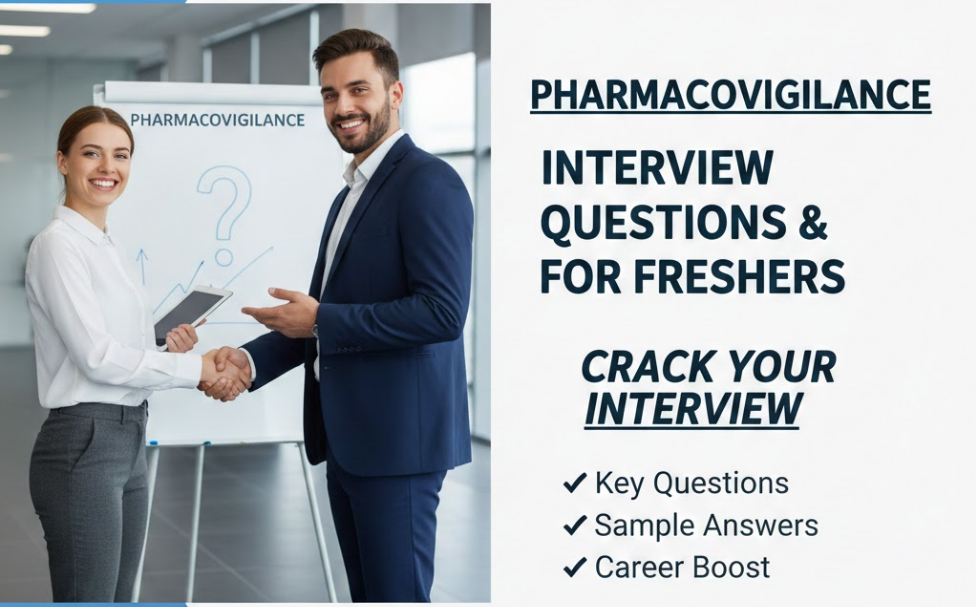
Pharmacovigilance Interview Questions
1. What is Pharmacovigilance?
Answer: Pharmacovigilance is defined as the science and set of activities concerned with the detection, assessment, understanding, and prevention of adverse effects or any other medicine-related problems.
The term originates from:
- Pharmakon (Greek for drug)
- Vigilare (Latin for to keep watch)
Pharmacovigilance ensures that medicines available in the market continue to demonstrate a favorable benefit–riskratio when used by the general population, beyond controlled clinical trial environments.
2. Why is Pharmacovigilance necessary in healthcare?
Answer: Pharmacovigilance is necessary because:
- Clinical trials involve limited patient populations
- Rare, delayed, or population-specific adverse reactions may not be detected before approval
- Real-world use involves polypharmacy, comorbidities, and long-term exposure
By identifying, evaluating, and minimizing drug-related risks, pharmacovigilance:
- Enhances patient safety
- Reduces morbidity and mortality
- Supports rational drug use
- Builds public confidence in healthcare systems
3. What is an Adverse Drug Reaction (ADR)?
Answer: An Adverse Drug Reaction (ADR) is a harmful, unintended, and undesirable response to a medicinal product that occurs at doses normally used in humans for prophylaxis, diagnosis, or therapy.
ADRs can significantly impact:
- Patient adherence
- Treatment outcomes
- Healthcare costs
- Regulatory decisions
Examples include:
- Hepatotoxicity due to paracetamol overdose
- Anaphylaxis caused by penicillin
- Stevens–Johnson syndrome induced by certain anticonvulsants
4. Difference between Adverse Event (AE) and Adverse Drug Reaction (ADR)
Answer: An Adverse Event (AE) is any untoward medical occurrence in a patient receiving a medicinal product, regardless of causal relationship.
An ADR, however, implies a reasonable possibility of a causal relationship between the drug and the reaction.
In pharmacovigilance practice, distinguishing between AE and ADR is essential for accurate reporting and regulatory evaluation.
5. What are the primary objectives of Pharmacovigilance?
Answer: The key objectives of pharmacovigilance include:
- Early identification of new or rare adverse reactions
- Continuous evaluation of known safety concerns
- Prevention of avoidable drug-related harm
- Optimization of benefit–risk balance
- Support for regulatory actions such as label updates
- Promotion of safe and effective use of medicines
6. What are the different types of Adverse Drug Reactions?
Answer: ADRs are commonly classified into six types:
- Type A (Augmented): Dose-dependent and predictable
- Type B (Bizarre): Dose-independent and unpredictable
- Type C (Chronic): Associated with long-term therapy
- Type D (Delayed): Occur after prolonged latency
- Type E (End-of-use): Withdrawal effects
- Type F (Failure): Therapeutic failure due to resistance or interactions
Understanding ADR classification helps in risk evaluation and management.
7. What is an Individual Case Safety Report (ICSR)?
Answer: An Individual Case Safety Report (ICSR) is a structured document containing information about a single patient who experienced an adverse event or reaction associated with a medicinal product.
Key components include:
- Patient demographics
- Suspected and concomitant drugs
- Adverse event description
- Seriousness and outcome
- Reporter information
ICSRs form the foundation of global pharmacovigilance databases.
8. What are the valid criteria for an Individual Case Safety Report (ICSR)?
Answer: For an Individual Case Safety Report (ICSR) to be considered valid in pharmacovigilance, it must contain four essential minimum criteria.
1. Identifiable Patient
2. Identifiable Reporter
3. Suspected Medicinal Product
4. Suspected Adverse Event or Adverse Drug Reaction
9. What is the role of a Pharmacovigilance Associate?
Answer: A Pharmacovigilance Associate is responsible for:
- Case intake and triage
- ICSR processing and data entry
- Medical coding using MedDRA and WHO-DD
- Narrative preparation
- Case quality review
- Regulatory submissions within timelines
- Compliance with SOPs and global guidelines
Freshers typically begin their careers as Drug Safety Associates or PV Executives.
10. What is MedDRA and why is it important?
Answer: MedDRA (Medical Dictionary for Regulatory Activities) is a standardized international medical terminology used for coding adverse events, indications, and medical history.
Its hierarchical structure ensures:
- Consistency in safety reporting
- Reliable data analysis
- Efficient signal detection
- Global regulatory acceptance
11. What is WHO-Drug Dictionary?
Answer: The WHO-Drug Dictionary is a global reference database used for coding medicinal products in pharmacovigilance systems.
It enables:
- Accurate identification of active substances
- Standardized drug classification
- International data harmonization
12. What is Signal Detection in Pharmacovigilance?
Answer: Signal detection is the scientific process of identifying new or emerging safety concerns related to medicinal products by analyzing aggregated safety data.
Signals may result in:
- Label changes
- Risk minimization strategies
- Regulatory warnings
- Product withdrawal in severe cases
13. What is Causality Assessment?
Answer: Causality assessment evaluates the likelihood that a drug caused a reported adverse reaction.
Commonly used methods include:
- WHO-UMC causality scale
- Naranjo probability scale
This assessment is crucial for regulatory decision-making.
14. What are the sources of ADR data?
Answer: ADR data may originate from:
- Healthcare professionals
- Patients and consumers
- Clinical trials
- Scientific literature
- Post-marketing surveillance programs
- Spontaneous reporting systems
15. What is Pharmacovigilance in Clinical Trials?
Answer: In clinical research, pharmacovigilance focuses on:
- Monitoring adverse events
- Reporting Serious Adverse Events (SAEs)
- Ensuring regulatory compliance
- Safeguarding trial participants
16. What is Post-Marketing Surveillance (PMS)?
Answer: Post-Marketing Surveillance involves continuous monitoring of drug safety after market authorization.
It helps identify:
- Rare adverse reactions
- Long-term risks
- Drug-drug interactions
- Special population effects
17. What is the scope of Pharmacovigilance as a career?
Answer: Pharmacovigilance offers vast career opportunities due to:
- Increasing regulatory scrutiny
- Global outsourcing of PV services
- Expansion of clinical research
- Technological advancements
Opportunities exist in:
- Pharmaceutical companies
- CROs
- Regulatory agencies
- Hospitals
- Global safety service providers
18. What guidelines govern Pharmacovigilance?
Answer: Major guidelines include:
- ICH Guidelines
- WHO PV standards
- FDA regulations
- EMA guidelines
- CDSCO regulations (India)
19. What challenges exist in Pharmacovigilance?
Answer: Challenges include:
- Under-reporting of ADRs
- Incomplete case data
- Strict regulatory timelines
- Continuous guideline updates
- Data quality management
20. What is the future of Pharmacovigilance?
Answer: The future of pharmacovigilance is highly promising due to:
- Artificial intelligence and automation
- Big data analytics
- Real-world evidence integration
- Digital health technologies
- Increased patient involvement
Final Interview Preparation Tips for Freshers
- Build strong conceptual clarity
- Focus on patient safety perspective
- Learn regulatory terminology
- Improve medical writing skills
- Demonstrate willingness to learn
- Stay updated with PV trends
- Maintain ethical and professional mindset
Important Note for Pharmacovigilance Job Aspirants
- Always ensure that your resume is ATS-friendly (Applicant Tracking System compliant).
Many pharmaceutical companies, CROs, and global safety service providers use ATS software to filter resumes before shortlisting candidates for interviews. - An ATS-optimized resume should include:
- Relevant pharmacovigilance keywords
- Clear and standard section headings
- Simple formatting (no tables, graphics, or heavy designs)
- Job-specific skills such as ICSR processing, ADR reporting, MedDRA, WHO-DD, regulatory guidelines, etc.
- Remember that strong theoretical knowledge alone is not sufficient to crack pharmacovigilance interviews.
Practical understanding of interview patterns, real-time questions, case scenarios, resume screening methods, and communication skills is equally important.
- If you want regular and structured guidance on:
- How to crack pharmacovigilance interviews
- Common fresher interview questions
- ATS-friendly resume building
- Career growth strategies in drug safety
👉 Join our Telegram channel 👉 Join now, where we consistently share interview-focused content, expert tips, and career guidance specially designed for pharmacy and life-science graduates.