


Introduction
The study of phytoconstituents, particularly terpenoids like citral, holds immense importance in the field of phytochemistry and natural product pharmacology. Citral is a lemon-scented aldehyde widely distributed in the essential oils of several medicinal and aromatic plants. It is primarily known for its flavoring, fragrance, and therapeutic applications in the food, cosmetic, and pharmaceutical industries. Understanding the process of isolating, identifying, and analyzing citral is a key step in unlocking its full potential and ensuring the reproducibility and reliability of herbal preparations.

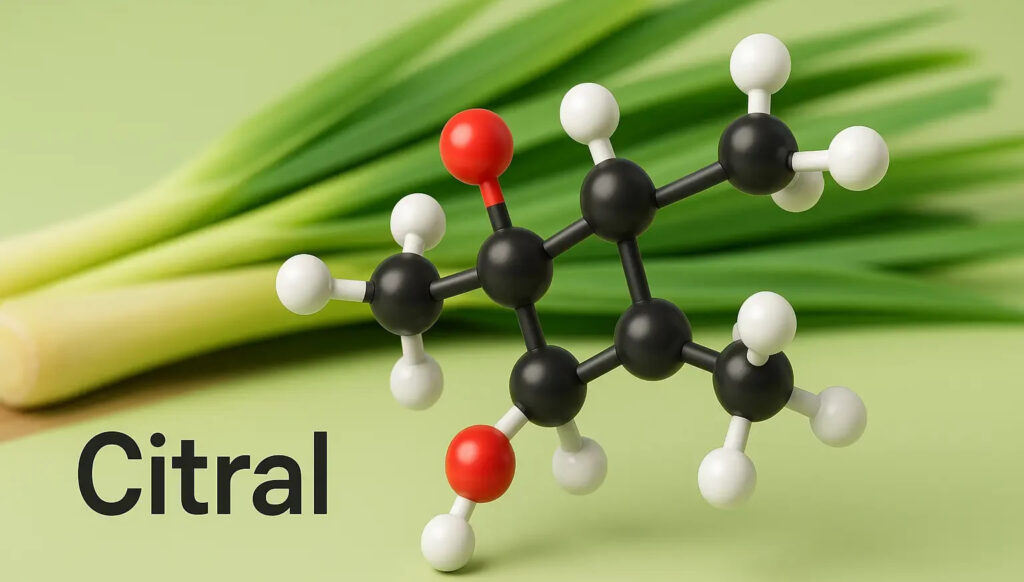
Citral exists as a mixture of two geometric isomers—geranial (trans-isomer, also known as citral A) and neral (cis-isomer, also known as citral B). These isomers contribute not only to the citrus aroma of the essential oil but also exhibit distinct pharmacological properties. Both compounds share the same molecular formula (C₁₀H₁₆O) but differ in the spatial orientation of their functional groups, affecting their reactivity and interactions.
Botanical Sources of Citral
The following plants are known for their significant citral content:
- Cymbopogon citratus (Lemongrass): One of the most important commercial sources of citral. The essential oil derived from its leaves may contain 70–80% citral, making it a valuable crop for the essential oil industry.
- Backhousia citriodora (Lemon myrtle): Perhaps the richest natural source of citral, with up to 90–98% citral content, surpassing even lemongrass.
- Litsea cubeba (May chang): A species native to Southeast Asia, with essential oil containing 65–75% citral.
- Melissa officinalis (Lemon balm): Contains citral along with citronellal and geraniol, contributing to its sedative and antimicrobial activity.
- Citrus species (like lemon, lime, and orange peels): While not the richest sources, they contain minor but significant amounts of citral contributing to their aroma.
These plants are not only valued for their aroma but also have long histories of traditionalmedicinal uses, which modern science is now validating through phytochemical and pharmacological studies.
Chemical Structure and Properties of Citral
Chemically, citral is a monoterpene aldehyde that is both volatile and lipophilic. Its structure includes a conjugated diene system and a terminal aldehyde group, making it highly reactive in both electrophilic and nucleophilic substitution reactions. The presence of two double bonds allows it to easily undergo oxidation, isomerization, and polymerization, especially when exposed to heat, light, or air.
- Geranial (Citral A): The trans-isomer, which is more pungent and has a stronger lemon-like odor.
- Neral (Citral B): The cis-isomer, which is softer and sweeter in scent.
Because of these features, citral is highly sought after in the perfume, food, and pharmaceutical industries and is often used as a starting material in the synthesis of ionones and vitamins such as Vitamin A.
Extraction Techniques for Citral
The process of obtaining citral begins with the extraction of essential oils, which are complex mixtures of volatile phytochemicals. The methods used must be chosen carefully to preserve the integrity and concentration of citral:
1. Steam Distillation
Steam distillation is the traditional and most widely adopted method for extracting essential oils from plant materials:
- Procedure: Plant material (usually fresh or dried leaves or peels) is exposed to steam. The heat causes the cell walls to rupture, releasing the volatile oils, which vaporize and are condensed back into liquid form.
- Separation: The distillate typically separates into two layers—an upper oil layer (essential oil) and a lower aqueous phase (hydrosol).
- Considerations: Citral is thermolabile and may degrade if exposed to prolonged high temperatures, so the distillation time and temperature should be optimized.
2. Solvent Extraction
Solvent extraction is ideal for plants with low essential oil yield or when thermal degradation must be avoided:
- Procedure: The plant material is soaked in a suitable organic solvent such as hexane or ethanol, allowing the volatile components to dissolve.
- Post-processing: The solvent is evaporated under reduced pressure to yield a concrete or oleoresin, which contains citral.
- Advantages: Higher yield, good preservation of delicate compounds.
3. Supercritical Fluid Extraction (SFE)
This is a modern, clean, and efficient extraction technique using CO₂ in its supercritical state as a solvent:
- Mechanism: Under high pressure and moderate temperature, CO₂ behaves like both a gas and a liquid, efficiently penetrating plant material and dissolving non-polar compounds like citral.
- Advantages: Highly selective, leaves no solvent residue, environmentally friendly.
- Challenges: Expensive equipment and technical expertise required.
Isolation and Purification of Citral
After extraction, citral must be separated from other terpenes and volatile compounds. The process of isolation involves techniques that exploit differences in boiling points, polarity, and molecular size.
1. Fractional Distillation
This is used when working with large quantities of essential oil:
- Citral, having a relatively high boiling point (~229 °C), can be separated from lighter components by vacuum distillation, which reduces the boiling point and minimizes degradation.
- While effective, this method requires precise control of temperature and pressure.
2. Column Chromatography
This is a highly effective technique for laboratory-scale purification:
- Stationary phase: Silica gel is commonly used.
- Mobile phase: A gradient solvent system of hexane to ethyl acetate is employed to elute compounds by increasing polarity.
- Citral, being moderately polar, elutes at a specific solvent strength, allowing it to be collected separately.
3. Preparative Thin Layer Chromatography (TLC)
Useful for small-scale, precise isolation:
- The compound is separated on a silica-coated plate.
- The band corresponding to citral (based on Rf value) is scrapped, extracted, and purified further.
Identification of Citral
Several techniques are employed to confirm the identity and structure of citral:
1. Thin Layer Chromatography (TLC)
- Procedure: A small spot of extract is applied on a silica gel plate and developed using a non-polar solvent.
- Visualization: Citral appears as a colored spot after spraying with vanillin-sulfuric acid and heating.
- Rf Value: Compared with a standard solution of citral.
2. Gas Chromatography-Mass Spectrometry (GC-MS)
This is considered the gold standard for identification:
- Citral isomers show distinct retention times and mass spectra.
- The mass spectrum shows a base peak at m/z 69 (a common ion for monoterpenes) and molecular ion at m/z 152.
- The fragmentation pattern confirms the presence of aldehyde and conjugated double bonds.
3. Fourier Transform Infrared Spectroscopy (FTIR)
FTIR detects functional groups:
- Aldehyde (C=O) stretch at 1720 cm⁻¹.
- C=C stretches (alkenes) between 1640–1680 cm⁻¹.
- C-H stretches from methyl and methylene groups at 2850–2950 cm⁻¹.
4. Nuclear Magnetic Resonance (NMR)
NMR provides detailed structural information:
- ¹H NMR: Aldehyde proton appears as a singlet at δ ~9.5–10 ppm.
- ¹³C NMR: Shows signals at δ ~190 ppm (for the carbonyl carbon), ~130 ppm (for alkenes), and ~20 ppm (for methyl groups).
- Differentiation between geranial and neral isomers is possible based on chemical shifts and coupling patterns.
Quantitative Analysis of Citral
1. Titrimetric Method
- Based on reaction with hydroxylamine hydrochloride, forming an oxime.
- The unreacted hydroxylamine is back-titrated using standard acid (HCl).
- The difference in volume gives the citral content in the sample.
2. Spectrophotometry
- Citral forms a colored complex with 2,4-dinitrophenylhydrazine.
- The absorbance of the hydrazone complex is measured at 360–380 nm.
- A calibration curve with standard citral is used for quantification.
3. Gas Chromatography (GC)
- Allows precise quantification by comparing the peak area of sample citral with that of a known standard.
- Highly sensitive and suitable for complex mixtures.
Pharmacological Properties of Citral
Citral is not just an aroma compound—it has a broad spectrum of biological activities:
1. Antimicrobial
- Citral disrupts microbial membranes and interferes with DNA replication.
- Effective against Escherichia coli, Staphylococcus aureus, Candida albicans, etc.
2. Anti-inflammatory
- Reduces the expression of COX-2, iNOS, and inflammatory cytokines like TNF-α.
- Inhibits the NF-κB signaling pathway, which plays a key role in inflammation.
3. Antioxidant
- Citral scavenges reactive oxygen species (ROS).
- Prevents lipid peroxidation and enhances cellular redox balance.
4. Anticancer
- Induces apoptosis in cancer cells through mitochondrial pathways.
- Suppresses cell proliferation and inhibits angiogenesis.
Conclusion
The phytoconstituent citral, found abundantly in plants like Cymbopogon citratus and Backhousia citriodora, represents a natural compound of considerable economic, therapeutic, and scientific importance. Through appropriate extraction, isolation, identification, and quantification techniques, citral can be obtained in pure form for further use in pharmaceuticals, cosmetics, and food industries. Its diverse pharmacological activities make it a promising candidate for future drug development. Continued research and development in this area will not only improve the quality of herbal products but also broaden the therapeutic applications of this versatile compound.