


Dispersive and Fourier-Transform Infrared (FTIR) Spectrometers: Infrared (IR) spectroscopy is a widely used analytical technique that provides valuable information about the molecular structure and functional groups of a compound by measuring the absorption of infrared radiation. The two primary types of IR spectrometers used in laboratories are dispersive infrared spectrometers and Fourier-transform infrared (FTIR) spectrometers. Each type of instrument operates on distinct principles and utilizes different components to analyze samples. The choice between these instruments depends on various factors such as spectral resolution, speed of analysis, and sensitivity.
Dispersive Infrared Spectrometers
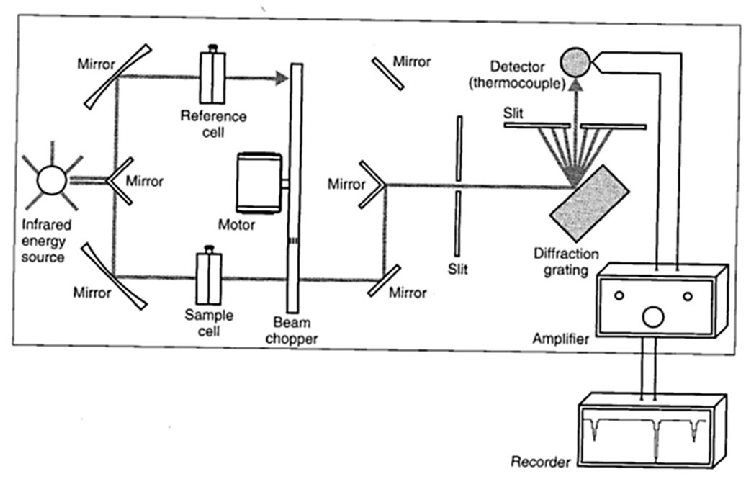
Dispersive IR spectrometers are among the earliest types of IR spectroscopic instruments. They use a monochromator with a diffraction grating or prism to disperse infrared radiation into its component wavelengths before detection. These instruments operate using a scanning mechanism where each wavelength is measured sequentially, leading to longer acquisition times.
Components of a Dispersive Infrared Spectrometer
- Infrared Radiation Source: The IR source in a dispersive spectrometer emits a broad range of infrared wavelengths. Common sources include:
Globar (Silicon Carbide Rod): A heated silicon carbide rod that emits a continuous spectrum of infrared radiation.
Nernst Glower: A ceramic rod composed of rare earth oxides that requires preheating before it becomes conductive and emits IR radiation.

Tungsten-Halogen Lamp: Used for near-infrared (NIR) applications, emitting radiation in the 0.7–2.5 µm range.
- Sample Handling System: Samples can be introduced in various physical states such as solid, liquid, or gas. The sample handling system includes cells and sample holders made of IR-transparent materials like sodium chloride (NaCl) or potassium bromide (KBr).
- Monochromator: A critical component that disperses the infrared light into its individual wavelengths using:
Prisms: Made from materials like potassium bromide (KBr) or calcium fluoride (CaF₂) to disperse IR radiation.
Diffraction Gratings: More commonly used, as they provide better spectral resolution and efficiency by diffracting light at specific angles.
- Detectors: The dispersed IR light reaches a detector that measures the intensity of each wavelength sequentially. Common detectors in dispersive spectrometers include:
Thermocouples: Convert thermal energy from absorbed IR radiation into an electrical signal.
Bolometers: Detect changes in resistance due to heating by absorbed IR radiation.
Pyroelectric Detectors: Use materials like deuterated triglycine sulfate (DTGS) to generate electrical signals upon infrared absorption.
- Data Processing and Display System: The measured signals are processed, and the resulting IR spectrum is displayed on a chart recorder or digital interface. The spectrum consists of characteristic absorption bands corresponding to molecular vibrations.
Advantages of Dispersive Infrared Spectrometers
- High spectral resolution due to the use of monochromators.
- Suitable for applications requiring selective wavelength analysis.
- Effective in qualitative and quantitative molecular analysis.
Limitations of Dispersive Infrared Spectrometers
- Slow scanning process, as each wavelength is analyzed sequentially.
- Low signal-to-noise ratio due to mechanical components introducing noise.
- Less sensitivity compared to modern FTIR spectrometers.
Fourier-Transform Infrared (FTIR) Spectrometers
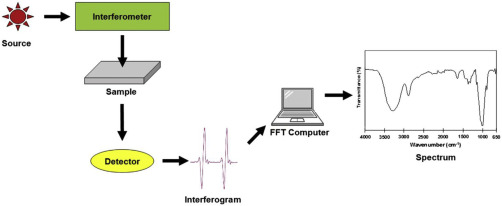
Fourier-transform infrared (FTIR) spectrometers revolutionized IR spectroscopy by enabling rapid and high-resolution spectral acquisition. Unlike dispersive instruments, FTIR spectrometers do not use a monochromator; instead, they measure all wavelengths simultaneously and use Fourier-transform mathematical techniques to obtain spectra.
Components of an FTIR Spectrometer
- Infrared Radiation Source: Similar to dispersive instruments, FTIR spectrometers use sources such as Globar, Nernst glower, or tungsten-halogen lamps to emit a continuous infrared spectrum.
- Interferometer: The core of FTIR instrumentation, replacing the monochromator in dispersive systems. It consists of:
Beam Splitter: A partially reflective and partially transmissive optical element that divides incoming infrared light into two beams.
Fixed Mirror: Reflects one part of the split beam back to the beam splitter.
Moving Mirror: Moves back and forth to vary the optical path difference between the two beams.
Interference Pattern: When the beams recombine, they create an interferogram, a signal that contains all spectral information.
- Sample Handling System: Similar to dispersive instruments, samples can be analyzed as solids, liquids, or gases. Attenuated Total Reflectance (ATR) is a common accessory used for direct sample measurement without extensive preparation.
- Detector: The interferogram is detected by a highly sensitive detector, commonly:
Deuterated Triglycine Sulfate (DTGS) Detectors: Pyroelectric detectors used for general IR measurements.
Mercury Cadmium Telluride (MCT) Detectors: More sensitive and suitable for low-intensity IR signals but require cooling with liquid nitrogen.
- Fourier Transform Processor and Computer: The detected interferogram undergoes mathematical transformation (Fourier transform) to convert it into an interpretable IR spectrum. Modern FTIR instruments are equipped with computers that process data, apply corrections, and display results in real time.

Advantages of FTIR Spectrometers
- Speed: Measures all wavelengths simultaneously, drastically reducing acquisition time compared to dispersive instruments.
- Higher Sensitivity: Signal averaging enhances sensitivity and minimizes noise, leading to improved detection limits.
- Better Signal-to-Noise Ratio: Fourier transform techniques enhance spectral quality.
- Wider Wavelength Range: FTIR covers a broad spectral range from near-infrared (NIR) to mid-infrared (MIR) and far-infrared (FIR).
- Versatility: Compatible with various sampling techniques, including ATR, transmission, and diffuse reflectance.
Limitations of FTIR Spectrometers
- Higher cost compared to dispersive instruments.
- Complex data processing requiring advanced computational techniques.
- More susceptible to environmental conditions such as humidity and CO₂ interference.
Comparison of Dispersive and FTIR Spectrometers
| Feature | Dispersive IR Spectrometer | FTIR Spectrometer |
| Scanning Method | Sequential wavelength scanning | All wavelengths measured simultaneously |
| Spectral Acquisition Time | Longer | Shorter (few seconds) |
| Sensitivity | Moderate | High (due to signal averaging) |
| Resolution | Moderate to high | High (depends on interferometer design) |
| Signal-to-Noise Ratio | Lower | Higher (Fourier transform enhances signal) |
| Cost | Lower | Higher |
| Sample Preparation | Requires careful preparation | More flexible, ATR allows direct analysis |
Applications of Dispersive and FTIR Spectrometers
Both types of IR spectrometers find applications in various scientific and industrial fields:
- Pharmaceuticals: Identification of drug compounds, quality control, and stability testing.
- Environmental Analysis: Detection of pollutants, monitoring of atmospheric gases.
- Forensic Science: Analysis of chemical residues, drug identification.
- Material Science: Characterization of polymers, coatings, and composite materials.
- Food Industry: Detection of adulterants, quality assessment of food products.
- Biomedical Research: Analysis of biomolecules, identification of disease markers.
Conclusion
Infrared spectroscopy is an indispensable analytical tool with a wide range of applications. While dispersive IR spectrometers offer high-resolution analysis through monochromators, FTIR spectrometers have largely replaced them due to their superior speed, sensitivity, and signal-to-noise ratio. The choice between these instruments depends on the specific analytical requirements, cost considerations, and desired spectral quality. Advances in FTIR technology continue to enhance the capabilities of IR spectroscopy, making it an essential technique in modern scientific research and industrial applications.