


1. Introduction of Vaccine Safety Surveillance
Vaccine Safety Surveillance: Vaccines represent one of the most significant medical achievements in human history, having drastically reduced morbidity and mortality associated with infectious diseases. However, like all medical interventions, vaccines are not completely devoid of risks. Ensuring their safety is a crucial component of public health, particularly in maintaining confidence in immunization programs. Vaccine safety surveillance, vaccine pharmacovigilance, monitoring of vaccination failure, and managing adverse events following immunization (AEFI) are essential pillars that support a robust immunization infrastructure. This comprehensive overview aims to elaborate on these interconnected domains, offering a deeper understanding of how they contribute to the overall safety and efficacy of vaccination programs globally.

2. Vaccine Safety Surveillance
Definition and Purpose
Vaccine safety surveillance is defined as the continuous and systematic process of collecting, analyzing, interpreting, and disseminating data regarding adverse events that occur post-vaccination. The primary objective is to detect any potential risks or safety concerns promptly and implement corrective measures to mitigate harm to public health.
Core Objectives:
- To monitor and evaluate the safety profile of vaccines.
- To detect new, rare, or unexpected adverse events.
- To ensure public trust in vaccines and immunization programs.
- To support regulatory decisions, including vaccine licensure and recommendation updates.
Types of Surveillance:
1. Passive Surveillance: Relies on spontaneous reporting from healthcare providers, patients, and manufacturers.
Examples: Vaccine Adverse Event Reporting System (VAERS) in the USA, Yellow Card Scheme in the UK.
2. Active Surveillance: Involves proactive monitoring, such as cohort event monitoring and sentinel site surveillance. Utilizes data from healthcare records, immunization registries, and electronic medical databases.
Examples: Vaccine Safety Datalink (VSD) in the USA, AusVaxSafety in Australia.
3. Enhanced Surveillance: Intensified monitoring during specific circumstances, such as introduction of a new vaccine or pandemic response. Includes targeted investigation of signals detected in passive systems.
Tools and Technologies Used:
- Electronic Health Records (EHR)
- Big data analytics
- Machine learning for signal detection
- Global databases like WHO’s VigiBase and EudraVigilance by EMA
Challenges in Vaccine Safety Surveillance:
- Underreporting and reporting bias
- Difficulty in establishing causality
- Variability in data quality and timeliness
Importance in Pandemic Contexts:
The COVID-19 pandemic underscored the critical need for real-time, transparent, and collaborative safety surveillance mechanisms to monitor novel vaccines rolled out at an unprecedented scale.
3. Vaccine Pharmacovigilance
Definition: Vaccine pharmacovigilance is a specialized branch of pharmacovigilance that deals exclusively with the science and activities related to the detection, assessment, understanding, and prevention of adverse effects or any other vaccine-related problems.
Key Functions:
- Signal Detection: Identifying new or known risks through statistical analysis.
- Causality Assessment: Determining the likelihood that a vaccine caused an adverse event.
- Risk Assessment: Evaluating the frequency, severity, and potential consequences of adverse events.
- Risk Management: Implementing strategies to minimize potential harms.
- Communication: Informing stakeholders, including the public, about vaccine safety in a transparent and timely manner.
Stakeholders Involved:
- National regulatory agencies (e.g., FDA, EMA, CDSCO)
- World Health Organization (WHO)
- Uppsala Monitoring Centre (UMC)
- Vaccine manufacturers
- Healthcare professionals and public health authorities
Vaccine-Specific Considerations:
Vaccines differ from drugs in several key ways:
- Administered to healthy individuals, often children
- Requires a high safety standard
- Sometimes includes adjuvants, preservatives, or live attenuated organisms
- Involves mass administration in short time frames
Post-Marketing Surveillance (Phase IV Studies):
Critical for continuing safety evaluation after vaccines are licensed and used in the general population. These studies help identify rare adverse events not observed in pre-licensure trials due to limited sample sizes.
Global Initiatives:
- WHO’s Global Vaccine Safety Initiative (GVSI)
- Brighton Collaboration: Standardizes definitions and terminologies related to AEFI
4. Vaccination Failure
Definition: Vaccination failure is defined as the occurrence of a vaccine-preventable disease in an individual who has been fully vaccinated according to recommended schedules.
Types of Vaccination Failure:
1. Primary Vaccine Failure: No immune response is generated after vaccination.
Causes include:
- Improper vaccine storage or administration
- Host immune factors (e.g., genetic variability, immunodeficiency)
- Interference by maternal antibodies (especially in infants)
Secondary Vaccine Failure: Initial immune response occurs but wanes over time, leading to susceptibility. Seen in diseases like pertussis, mumps, and varicella.
Contributing Factors:
- Incomplete vaccination schedules
- Antigenic drift or shift in the pathogen
- Malnutrition or underlying health conditions
- Variability in individual immune responses
Detection and Evaluation:
- Surveillance data analysis
- Serological testing for antibodies
- Clinical case investigations
Implications of Vaccination Failure:
- Outbreaks in highly vaccinated populations
- Erosion of public trust
- Reassessment of booster schedules and vaccine formulations
Strategies to Address Failure:
- Implementation of booster doses
- Improved vaccine formulations
- Public health education
- Enhanced cold chain and logistics management
5. Adverse Events Following Immunization (AEFI)
Definition: AEFI is defined as any untoward medical occurrence that follows immunization and does not necessarily have a causal relationship with the usage of the vaccine. The event may be any unfavorable or unintended sign, abnormal laboratory finding, symptom, or disease.
Classification of AEFI (WHO):
| Type | Description |
| Vaccine Reaction | Caused by the inherent properties of the vaccine. |
| Programmatic Error | Caused by mistakes in vaccine preparation, handling, or administration. |
| Coincidental | Not related to the vaccine; occurs by chance after vaccination. |
| Injection Reaction | Related to anxiety or pain from the injection process. |
| Unknown | Cause remains indeterminate after investigation. |
Examples of AEFIs:
- Mild Reactions: Pain, redness, swelling at the injection site, low-grade fever, irritability.
- Moderate Reactions: Febrile seizures, allergic reactions, prolonged crying.
Severe Reactions (Rare):
Anaphylaxis
Thrombosis with thrombocytopenia syndrome (TTS)
Myocarditis or pericarditis (e.g., post mRNA COVID-19 vaccines)
Guillain-Barré Syndrome (GBS)
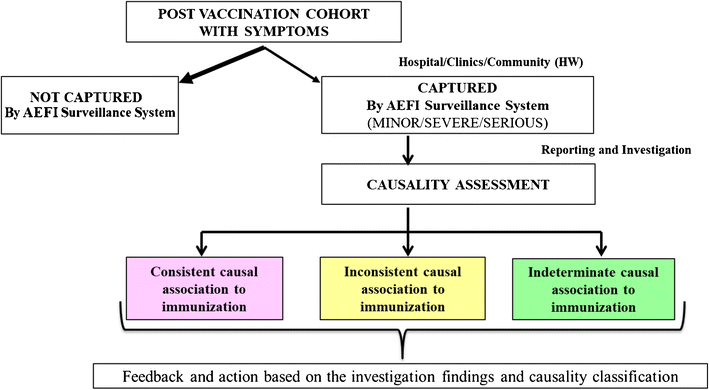
AEFI Surveillance and Response:
- Reporting: Prompt notification through national AEFI surveillance systems.
- Investigation: Detailed analysis of clinical data, vaccination history, and circumstances.
- Causality Assessment: Utilizes standardized algorithms to determine linkage to vaccine.
- Communication: Transparent dissemination of findings to healthcare workers and the public.
- Corrective Actions: If necessary, update product labels, issue advisories, or withdraw vaccines.
AEFI Committees: Most countries have established AEFI review committees comprising epidemiologists, immunologists, and pharmacovigilance experts to analyze data and recommend actions.
6. Integration of Surveillance and Pharmacovigilance Systems
Effective vaccine safety monitoring involves a seamless integration of surveillance and pharmacovigilance activities. Data triangulation from multiple sources enhances the detection of rare or delayed adverse events. Interoperability of health information systems and international collaboration further strengthen this network.
Real-world Case Studies:
- Rotavirus Vaccine and Intussusception: Early detection of this adverse event led to withdrawal and reformulation.
- COVID-19 Vaccines: Identification of rare events like TTS and myocarditis through global surveillance led to updated usage guidelines.
7. Ethical, Legal, and Social Considerations
- Informed Consent: Especially in mass immunization programs, individuals should be aware of potential risks.
- Data Privacy: Protecting personal health information in surveillance databases.
- Public Communication: Clear, science-based messaging to counter misinformation and vaccine hesitancy.
- Equity: Ensuring all populations benefit equally from vaccine safety measures.
Conclusion
Vaccine safety surveillance, pharmacovigilance, vaccination failure assessment, and AEFI monitoring are interdependent components that ensure the effectiveness and trustworthiness of immunization programs. In a globalized world where misinformation spreads rapidly, robust and transparent safety monitoring systems are essential not only for protecting public health but also for sustaining vaccine acceptance. Ongoing research, technological innovation, and global cooperation will continue to enhance our ability to detect, assess, and respond to vaccine-related risks in a timely and effective manner.
The journey of a vaccine does not end at approval; it continues with vigilant post-marketing safety evaluation that safeguards the health of generations to come.