


Typhoid fever, also known simply as typhoid, is a systemic infectious disease caused by the bacterium Salmonella enterica serovar Typhi (S. Typhi). It is a life-threatening illness primarily affecting the gastrointestinal tract and can lead to severe complications if not diagnosed and treated in time. The disease remains a major public health challenge in many low- and middle-income countries, particularly where access to clean water, sanitation, and hygiene is limited.

Despite significant advancements in antibiotics and vaccination, typhoid fever continues to be endemic in parts of Asia, Africa, and Latin America, where millions of people are at risk. The clinical presentation of typhoid is often non-specific, mimicking other febrile illnesses, which makes timely and accurate diagnosis crucial.
2. Definition
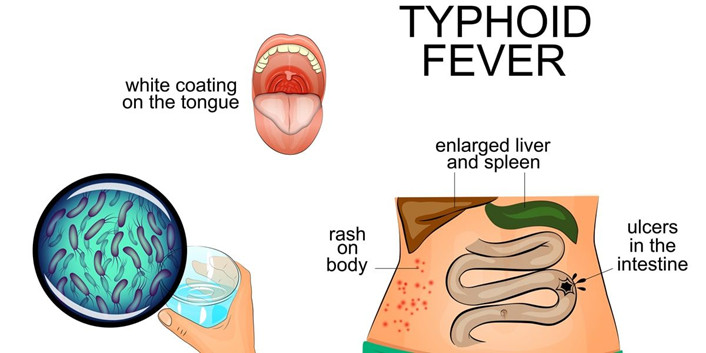
Typhoid fever is defined as a bacterial infection characterized by sustained high fever, abdominal discomfort, malaise, hepatosplenomegaly, and rose-colored rash, typically caused by Salmonella Typhi. It belongs to the broader category of enteric fevers, which also includes paratyphoid fever caused by S. Paratyphi A, B, and C.
The bacteria infiltrate the intestinal wall, invade the bloodstream, and spread to multiple organs, leading to systemic symptoms. Without appropriate therapy, typhoid fever may result in intestinal perforation, sepsis, neurological complications, or death.
3. Epidemiology of Typhoid Fever
3.1 Global Burden
Typhoid fever remains a global health burden, with an estimated 11–21 million cases and about 128,000–161,000 deaths annually (WHO, 2023). The disease is endemic in many developing regions with poor sanitation and limited access to safe drinking water.
3.2 High-Risk Areas
- South Asia: Particularly India, Bangladesh, Pakistan, and Nepal, which report the highest incidence.
- Sub-Saharan Africa: Increasing number of cases due to urbanization and poor sanitation.
- Latin America and the Caribbean: Moderate prevalence in some rural and peri-urban settings.
3.3 Age and Risk Factors
- Children under 15 years are most commonly affected.
- Travelers from industrialized nations visiting endemic areas.
- Immunocompromised individuals (e.g., HIV/AIDS).
- Occupational exposure, e.g., healthcare workers, food handlers.
- Overcrowding and slum living conditions.
4. Etiology of Typhoid Fever
Typhoid fever is caused by gram-negative, motile bacilli of the species Salmonella enterica subspecies enterica serotype Typhi.
- Salmonella Typhi is strictly human-adapted, meaning humans are the only known reservoir.
- The infection is transmitted fecal-orally—primarily through ingestion of contaminated food or water.
- The organism survives in the gastrointestinal tract, penetrates the intestinal mucosa, and spreads via lymphatic and hematogenous routes.
Other members of the same genus, such as S. Paratyphi A, B, and C, cause paratyphoid fever, a clinically similar but generally less severe illness.
5. Pathophysiology of Typhoid Fever
Step 1: Entry of Bacteria
Typhoid fever is caused by Salmonella enterica serotype Typhi. The bacteria usually enter the body through contaminated food or water. After ingestion, they pass through the stomach and survive the acidic environment.
Step 2: Invasion of Intestine
The bacteria reach the small intestine, where they attach to the intestinal lining, especially the Peyer’s patches (lymphoid tissue in the ileum). They penetrate the intestinal mucosa and enter the underlying lymphoid tissue.
Step 3: Spread to Lymph and Blood
From the intestinal tissue, the bacteria enter the mesenteric lymph nodes and then the bloodstream (bacteremia). At this stage, patients often develop early symptoms like fever, malaise, and body ache.
Step 4: Multiplication in Reticuloendothelial System
The bacteria are taken up by macrophages in the liver, spleen, and bone marrow. Instead of being destroyed, they survive and multiply inside these cells. This leads to enlargement of the liver and spleen.
Step 5: Secondary Bacteremia
After multiplying in these organs, the bacteria are released back into the blood in large numbers. This causes sustained high fever, abdominal pain, rose-spot rash, and other systemic symptoms.
Step 6: Intestinal and Systemic Effects
The bacteria return to the intestine through bile secretions. This can cause ulceration of Peyer’s patches, leading to abdominal pain, bleeding, or even perforation. Meanwhile, toxins and continuous infection in the blood affect many organs, explaining symptoms like cough, headache, and mental confusion.
Step 7: Carrier State
In some people, the bacteria hide in the gallbladder and persist, leading to a chronic carrier state (famous example: “Typhoid Mary”). These individuals can spread the disease even without symptoms.
6. Types of Typhoid and Enteric Fever
6.1 Typhoid Fever (Salmonella Typhi)
- Most common and severe form.
- High-grade fever, bradycardia, hepatosplenomegaly, abdominal pain, and rose spots.
6.2 Paratyphoid Fever (Salmonella Paratyphi A, B, C)
- Milder than typhoid.
- Similar clinical features but usually less toxic.
- Increasing incidence, especially of S. Paratyphi A in South Asia.
6.3 Chronic Carrier State
- Some individuals, especially older women with gallbladder disease, may become asymptomatic carriers, excreting S. Typhi in stool or urine for over a year.
- Example: Mary Mallon, also known as “Typhoid Mary,” a historical figure who spread typhoid despite being asymptomatic.
7. Clinical Manifestations
7.1 Incubation Period
- Usually 7–14 days, but can range from 3 to 60 days depending on host immunity and bacterial load.
7.2 Signs and Symptoms
- Sustained high fever (often rising in a stepwise fashion)
- Weakness and malaise
- Abdominal pain and discomfort
- Loss of appetite (anorexia)
- Constipation (early), followed by diarrhea (later stages)
- Hepatosplenomegaly
- Dry cough
- Bradycardia (Faget sign)
- Rose spots: Faint salmon-colored maculopapular rash on the trunk
- Delirium or “typhoid state” in severe cases
7.3 Complications
- Intestinal perforation and peritonitis
- Gastrointestinal hemorrhage
- Encephalopathy
- Myocarditis
- Hepatitis
- Sepsis
- Death, if untreated
8. Diagnosis of Typhoid Fever
8.1 Clinical Diagnosis
- Based on symptomatology and travel or exposure history.
- Rule out other tropical fevers like malaria, dengue, and leptospirosis.
8.2 Laboratory Diagnosis
- Blood culture: Most sensitive during the first week.
- Bone marrow culture: Gold standard, though invasive.
- Stool and urine culture: Useful in later stages.
- Widal test: Detects anti-O and anti-H antibodies (limited sensitivity/specificity).
- Typhidot and TUBEX tests: Rapid serological tests.
- PCR-based tests: High sensitivity but expensive.
9. Treatment of Typhoid Fever
9.1 Antibiotic Therapy
The mainstay of treatment is antibiotic therapy, which shortens the duration of illness, reduces complications, and prevents death.
First-line agents:
- Ceftriaxone (parenteral)
- Azithromycin
- Ciprofloxacin (in regions with low resistance)
Multidrug-Resistant (MDR) Typhoid:
- Resistance to ampicillin, chloramphenicol, and co-trimoxazole.
- Requires third-generation cephalosporins or azithromycin.
Extensively Drug-Resistant (XDR) Typhoid:
- Resistant to first-line and fluoroquinolone drugs.
- Treat with carbapenems (e.g., meropenem) or tigecycline.
9.2 Supportive Care
- Adequate hydration
- Antipyretics
- Nutritional support
- Monitoring for complications
10. Prevention and Control
10.1 Vaccination
Types of Typhoid Vaccines:
- Ty21a (oral live attenuated): Given in 4 doses over 7 days.
- Vi polysaccharide vaccine: Single-dose injectable vaccine.
- Conjugate vaccines (e.g., Typbar-TCV): Newer vaccines for children >6 months; longer protection.
10.2 Public Health Measures
- Improved sanitation
- Access to clean drinking water
- Food hygiene practices
- Health education
- Surveillance and outbreak management
Conclusion
Typhoid fever remains a significant public health issue, especially in developing countries where waterborne diseases continue to thrive due to inadequate sanitation. The disease’s insidious onset, nonspecific symptoms, and the emergence of drug-resistant strains pose major diagnostic and therapeutic challenges.
With effective antibiotic therapy, early diagnosis, and comprehensive public health strategies including vaccination and sanitation reforms, the global burden of typhoid can be significantly reduced. Moreover, as global travel increases, the importance of preventive measures such as pre-travel vaccination and food safety awareness becomes even more critical in controlling the spread of this persistent disease.