

The Cahn-Ingold-Prelog (CIP) priority rules, also known as sequence rules, are used to assign the absolute configuration of chiral centers as R (rectus, right) or S (sinister, left). These rules provide a systematic method for ranking substituents attached to a chiral center to determine the spatial arrangement of the atoms or groups around it.
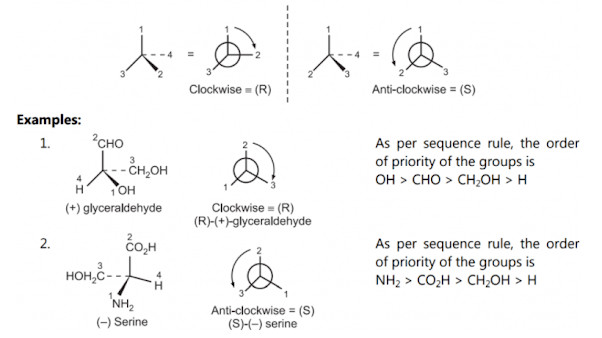
1. Assigning Priorities Based on Atomic Number
The first step in determining R/S configuration is to assign a priority to each substituent attached to the chiral center based on the atomic number of the atoms directly bonded to the chiral carbon. The rules are as follows:
Rule 1: Atomic Number
The substituent with the higher atomic number receives a higher priority.
Example: For a chiral carbon bonded to -H, -OH, -Cl, and -CH₃, chlorine (Cl) has the highest atomic number (17) and receives the highest priority (1), followed by oxygen (O, atomic number 8), carbon (C, atomic number 6), and hydrogen (H, atomic number 1).
Rule 2: Tie-Breaking by Atomic Number of Next Atoms
If two substituents have the same atom attached to the chiral center, you move to the next atom along the chain. The group with the first point of difference having a higher atomic number gets the higher priority.
Example: For a chiral center attached to -CH₂OH and -CH₂CH₃, the first atom is carbon in both cases. You then compare the atoms attached to these carbons: oxygen (O) in -CH₂OH vs. hydrogen (H) in -CH₂CH₃. Oxygen has a higher atomic number, so -CH₂OH has a higher priority.
Rule 3: Multiple Bonds Treated as Single Bonds
Atoms involved in multiple bonds (double or triple bonds) are treated as being bonded to an equivalent number of single-bonded atoms for the purpose of assigning priority.
Example: A C=O double bond is treated as a carbon bonded to two oxygens.
Orientation of the Lowest Priority Group
Once priorities have been assigned to the four substituents attached to the chiral center, the molecule should be viewed in such a way that the substituent with the lowest priority (4) is oriented away from the viewer (i.e., it points behind the plane of the paper).
Determining the Direction of the Sequence
With the lowest priority group positioned away from you, trace a path from priority 1 → 2 → 3:
If the sequence is clockwise, the chiral center is assigned the R configuration.
If the sequence is counterclockwise, the chiral center is assigned the S configuration.
Special Cases and Additional Rules
Rule 4: Isotopes
When dealing with isotopes of the same element, the isotope with the higher atomic mass receives a higher priority.
Example: In the case of deuterium (D, heavier isotope of hydrogen) and hydrogen (H), deuterium has higher priority than hydrogen.
Rule 5: Chiral Centers with Multiple Stereocenters
In molecules with more than one chiral center, the CIP rules are applied to each center individually. Each chiral center is evaluated separately for its R/S configuration.
Example of R/S Configuration Assignment
Consider a molecule with a chiral carbon attached to four groups: -H, -OH, -CH₃, and -Cl.
1. Assign priorities based on atomic number:
Cl (atomic number 17) → priority 1
OH (atomic number 8) → priority 2
CH₃ (C, atomic number 6) → priority 3
H (atomic number 1) → priority 4
2. Position the molecule so that the lowest priority group (H) is pointing away from you.
3. Trace the path from priority 1 → 2 → 3. If the direction is:
Clockwise → R configuration
Counterclockwise → S configuration
Summary of Sequence Rules
1. Prioritize the four substituents based on atomic number (higher atomic number = higher priority).
2. Break ties by moving to the next atoms along the chain.
3. Multiple bonds are treated as if the atoms were singly bonded to equivalent numbers of atoms.
4. Orient the lowest priority group away from you.
5. Determine the direction of the 1 → 2 → 3 sequence (clockwise = R, counterclockwise = S).
By following these steps, you can systematically assign the absolute configuration to any chiral center.