


Optical Rotation
Optical rotation, also known as optical activity, is a phenomenon where a substance rotates the plane of polarized light passing through it. This property is commonly observed in chiral compounds, which lack a plane of symmetry and exist in two mirror-image forms called enantiomers.

Chirality and Enantiomers
1. Chirality: Chirality is a fundamental geometric property of certain molecules where the molecular structure and its mirror image cannot be superimposed onto each other. This is analogous to the difference between a person’s left and right hands—they are mirror images but cannot perfectly align if placed one over the other.
- Characteristics: A molecule is considered chiral if it lacks an internal plane of symmetry and contains at least one chiral center, typically a carbon atom bonded to four different substituents.
- Significance: Chiral molecules are optically active, meaning they have the ability to rotate plane-polarized light. The direction and degree of this rotation depend on the spatial arrangement of atoms around the chiral center.
- Examples: Amino acids (except glycine), lactic acid, and many pharmaceutical compounds exhibit chirality.
2. Enantiomers: Enantiomers are a specific type of stereoisomers that exist in pairs. They are non-superimposable mirror images of each other, similar to how your left and right hands relate.
- Optical Activity: One enantiomer rotates plane-polarized light to the right (dextrorotatory, denoted as (+) or D-), while the other rotates it to the left (levorotatory, denoted as (−) or L-). Despite having identical physical and chemical properties in achiral environments, they behave differently in chiral environments such as biological systems.
- Pharmacological Relevance: Enantiomers can have drastically different biological activities. For example, one enantiomer of a drug may be therapeutically beneficial, while the other may be inactive or even harmful. This is crucial in drug design and development.
Examples:
- Thalidomide: One enantiomer was effective against morning sickness, while the other caused severe birth defects.
- Ibuprofen: The S-enantiomer is biologically active, while the R-enantiomer is less effective.
Mechanism of Optical Rotation
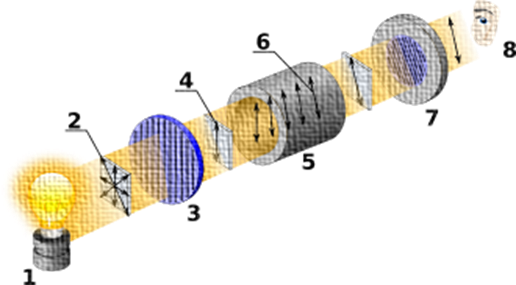
1. Interaction with Polarized Light: When plane-polarized light passes through a chiral substance, the interaction with asymmetrically arranged molecules causes a rotation of the plane of polarization.
2. Dextrorotatory and Levorotatory: If the rotation is clockwise (to the right), it is termed dextrorotatory (designated as ( + ). If the rotation is counterclockwise (to the left), it is levorotatory (designated as ( – ).
Measurement of Optical Rotation
1. Polarimeter: A polarimeter is the instrument used to measure optical rotation. It consists of a light source, a polarizer to create plane-polarized light, a sample tube, and an analyzer to detect the rotated plane of light.
2. Specific Rotation (α): The specific rotation is a standardized measure of optical rotation and is calculated using the formula:
[ α] = α/cl
where:
(α) is the observed optical rotation in degrees,
(c) is the concentration of the solution in g/mL,
(l) is the path length of the sample tube in decimeters.
Factors Influencing Optical Rotation
1. Nature of the Substance: The intrinsic chirality of a molecule, especially the presence and number of chiral centers, plays a crucial role in determining its optical activity. Different enantiomers of the same compound rotate light to the same degree but in opposite directions. Structural features such as functional groups, molecular rigidity, and electronic distribution also affect optical rotation.
Example: (R)- and (S)-lactic acid rotate light equally but in opposite directions due to their mirror-image structures.
2. Concentration: Optical rotation is directly proportional to the concentration of the optically active compound in solution. As concentration increases, more chiral molecules interact with the light, leading to greater rotation. This relationship is utilized in the formula for specific rotation:


where:
- [α] = specific rotation
- α = observed rotation
- l = path length (in dm)
- c = concentration (in g/mL)
3. Path Length: The distance the polarized light travels through the chiral medium (typically measured in decimeters) also influences the degree of rotation. A longer path allows for more interactions between light and chiral molecules, thus leading to a higher observed rotation.
4. Wavelength of Light: Optical rotation is wavelength-dependent, a phenomenon known as optical rotatory dispersion. Different wavelengths interact differently with the molecular electronic transitions of chiral compounds. The sodium D-line (589 nm) is commonly used as a standard wavelength in polarimetry, but variations in wavelength can lead to changes in both the magnitude and sign of the observed rotation.
Applications of Optical Rotation
1. Chirality Determination: Optical rotation is one of the primary techniques used to determine the chiral nature of a compound. By measuring the degree and direction of rotation, scientists can identify whether a compound is dextrorotatory or levorotatory. It also helps determine enantiomeric excess, an important parameter in stereochemistry, indicating the purity and ratio of enantiomers in a mixture.
2. Pharmaceutical Industry: In pharmaceutical development and quality control, optical rotation is employed to assess the identity, purity, and stereochemical integrity of chiral drug substances. Many active pharmaceutical ingredients (APIs) are chiral, and only one enantiomer may exhibit the desired therapeutic activity. Optical rotation provides a quick and reliable method for detecting impurities and verifying batch-to-batch consistency in drug manufacturing.
3. Food and Flavor Industry: A wide variety of natural products, such as essential oils (e.g., limonene, menthol), sweeteners, and flavoring agents, are optically active. Measuring optical rotation allows quality control analysts to verify the authenticity and composition of food ingredients and detect adulteration or degradation. It is especially useful for standardizing natural extracts used in the flavor and fragrance industries.
4. Chemical Synthesis: During the synthesis of chiral molecules, optical rotation is a valuable analytical tool used to monitor reaction progress and confirm stereoselectivity. Chemists rely on it to verify the formation of a specific enantiomer or to track the conversion of racemic mixtures into optically pure products. It complements other techniques such as chiral chromatography and NMR in synthetic chemistry workflows.
5. Biological Studies: Many biomolecules, including carbohydrates (like glucose) and amino acids, possess one or more chiral centers and are optically active. Optical rotation is widely used in biochemistry to identify and quantify these molecules in complex biological samples. It also plays a role in understanding structure–activity relationships in biochemical research, especially where stereochemistry affects biological function.
Challenges and Considerations in Optical Rotation
Optical rotation is a fundamental property used to investigate the chiral nature of molecules. Despite its wide applicability in pharmaceutical sciences, chemical analysis, and stereochemistry, several challenges and critical considerations must be addressed to ensure accurate and meaningful results. These challenges stem from both instrumental and sample-specific factors.
1. Sensitivity to Experimental Conditions:
- Optical rotation measurements are highly sensitive to environmental factors, particularly temperature and wavelength of light.
- Even minor deviations in these parameters can lead to significant discrepancies in the observed rotation.
- Hence, strict standardization of conditions, such as using the sodium D-line (589 nm) and maintaining constant temperature (typically 25°C), is essential for reproducibility.
2. Sample Concentration and Solvent Effects:
- Optical rotation is directly proportional to the concentration of the optically active substance and the path length of the sample tube.
- Inaccurate preparation or dilution of samples can result in misleading data.
- Additionally, the choice of solvent significantly influences rotation values, as solvents can interact with the solute, altering its optical properties.
3. Purity and Presence of Impurities:
- The presence of impurities, racemic mixtures, or degradation products can mask or distort the true optical rotation of the analyte.
- Even trace amounts of a second enantiomer can affect the measurement, particularly when assessing enantiomeric excess.
- Therefore, high sample purity is imperative for precise analysis.
4. Instrumental Calibration and Maintenance:
- Polarimeters require regular calibration using certified standards to maintain measurement accuracy.
- Dirty or scratched polarimeter tubes, faulty light sources, or detector misalignment can lead to systematic errors.
- Proper maintenance and quality assurance protocols are crucial for reliable operation.
5. Interpretation of Results:
- Optical rotation does not directly reveal the absolute configuration (R or S) of a compound; it only indicates the direction and degree of rotation.
- Interpretation often requires correlation with known standards or complementary techniques such as X-ray crystallography or circular dichroism.
- Relying solely on optical rotation without supporting data can lead to incorrect structural assignments.
6. Temperature-Induced Conformational Changes:
- Some compounds may exhibit temperature-dependent conformational changes, which affect their chiroptical properties.
- This adds a layer of complexity when comparing results across different studies or environments.
- Thermal equilibration of the sample before measurement helps ensure consistency.
7. Limitations in Complex Mixtures:
- Advanced separation methods (e.g., chiral chromatography) may be required prior to measurement.
- Optical rotation is most effective for analyzing pure compounds or simple mixtures.
- In complex formulations, such as multicomponent pharmaceuticals or herbal extracts, it becomes challenging to attribute the observed rotation to a specific compound.