

Aim: Effect of physostigmine and atropine on DRC of acetylcholine using frog rectus abdominis muscle and rat ileum respectively.
References:
- Rang, H. P., Dale, M. M., Ritter, J. M., & Flower, R. J. (2015). Rang & Dale’s Pharmacology. Elsevier.
- Katzung, B. G., Trevor, A. J. (2021). Basic & Clinical Pharmacology. McGraw Hill
- Tripathi, K. D. (2019). Essentials of Medical Pharmacology. Jaypee Brothers.
- Goodman & Gilman’s (2020). The Pharmacological Basis of Therapeutics. McGraw Hill.
Objective: To study the effect of physostigmine and atropine on the dose-response curve (DRC) of acetylcholine (ACh) using isolated frog rectus abdominis muscle and rat ileum preparations.
Principle: Acetylcholine (ACh) is a neurotransmitter that mediates its action via muscarinic and nicotinic receptors. Physostigmine, a reversible acetylcholinesterase inhibitor, enhances ACh activity by preventing its degradation. Atropine, a competitive muscarinic receptor antagonist, inhibits the action of ACh at muscarinic receptors. The frog rectus abdominis muscle is primarily used to study nicotinic receptor activity, while the rat ileum is used for muscarinic receptor studies. Changes in the dose-response curve (DRC) of ACh in the presence of these agents can help in understanding their pharmacological effects.
Materials Required:
- Frog rectus abdominis muscle preparation
- Rat ileum preparation
- Physiological solutions (Ringer’s solution for frog tissue, Tyrode’s solution for rat ileum)
- Acetylcholine (ACh) solution
- Physostigmine solution
- Atropine solution
- Organ bath (with aeration)
- Isotonic transducer
- Physiograph or PowerLab data acquisition system
- Micropipettes and syringes
- Tissue handling instruments (scissors, forceps, thread, etc.)
- Stopwatch
Procedure:
A. Effect of Physostigmine on the DRC of Acetylcholine in Frog Rectus Abdominis Muscle
1. Isolate the frog rectus abdominis muscle and mount it in an organ bath containing Ringer’s solution maintained at 25°C with continuous aeration.
2. Attach the muscle to an isotonic transducer and adjust the baseline tension.
3. Administer graded doses of ACh (e.g., 0.1, 0.2, 0.4, 0.8, 1.6 μg/ml) and record the contractile responses.
4. Plot the dose-response curve (DRC) for ACh.
5. Wash the preparation and add physostigmine (e.g., 0.1 μg/ml) into the organ bath.
6. Repeat the administration of graded doses of ACh and record the responses.
7. Compare the shift in the DRC before and after physostigmine treatment.
B. Effect of Atropine on the DRC of Acetylcholine in Rat Ileum
- Isolate a segment of rat ileum and mount it in an organ bath containing Tyrode’s solution at 37°C with continuous aeration.
- Attach the tissue to an isotonic transducer and maintain a resting tension of 1g.
- Administer graded doses of ACh and record the contractile responses.
- Plot the dose-response curve (DRC) for ACh.
- Wash the preparation and add atropine (e.g., 1 μg/ml) into the organ bath.
- Repeat the administration of graded doses of ACh and record the responses.
- Compare the shift in the DRC before and after atropine treatment.
Observations:
- In the presence of physostigmine, the DRC of ACh in frog rectus abdominis muscle is expected to shift to the left, indicating an enhanced response.
- In the presence of atropine, the DRC of ACh in rat ileum is expected to shift to the right, indicating inhibition of the response.
Results:
- Physostigmine potentiates the effect of ACh by inhibiting its degradation, leading to an increased response at lower doses.
- Atropine antagonizes the muscarinic effects of ACh, leading to a decreased response even at higher doses.

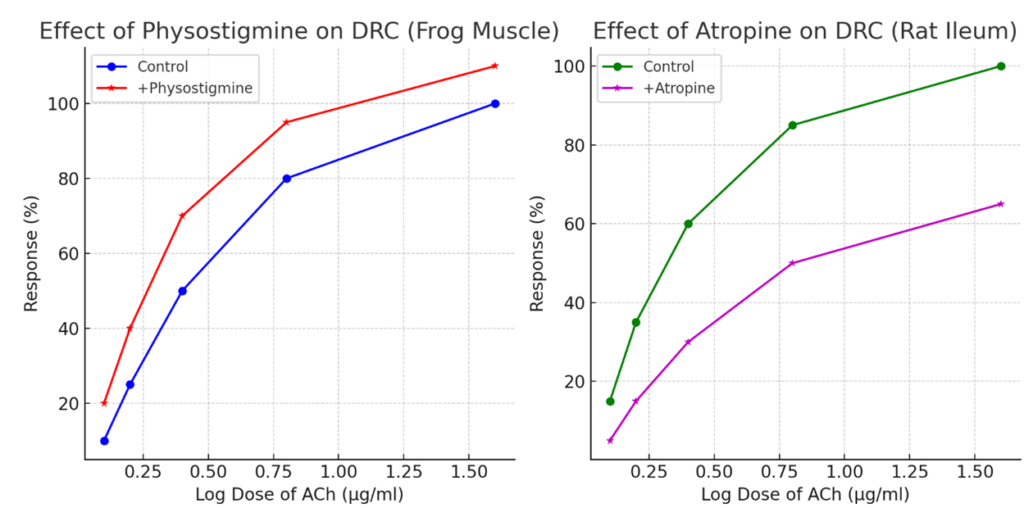
The dose-response curves (DRCs) showing the effects of physostigmine and atropine on acetylcholine responses:
Left graph (Frog Rectus Abdominis Muscle): Physostigmine shifts the curve leftward, indicating increased response due to acetylcholinesterase inhibition.
Right graph (Rat Ileum): Atropine shifts the curve rightward, indicating inhibition of the muscarinic effects of acetylcholine.
Conclusion: The experiment demonstrates the pharmacological modulation of acetylcholine responses by physostigmine (a cholinesterase inhibitor) and atropine (a muscarinic antagonist). Physostigmine enhances the action of ACh by preventing its breakdown, while atropine inhibits its action by blocking muscarinic receptors.
Precautions:
- Ensure proper aeration of the organ bath.
- Maintain appropriate physiological conditions (temperature, pH, and ionic balance).
- Use fresh preparations and solutions for accurate results.
- Allow sufficient washing time between drug applications to avoid carryover effects.