



Basic Life Processes
Life processes refer to the fundamental biological activities that sustain living organisms. These processes are essential for growth, development, reproduction, and adaptation to changing environmental conditions. All living organisms, whether unicellular or multicellular, rely on these vital functions to survive. The major life processes include nutrition, respiration, transportation, excretion, movement, reproduction, growth, and response to stimuli. Understanding these processes provides insights into how life is sustained and how organisms interact with their environment.

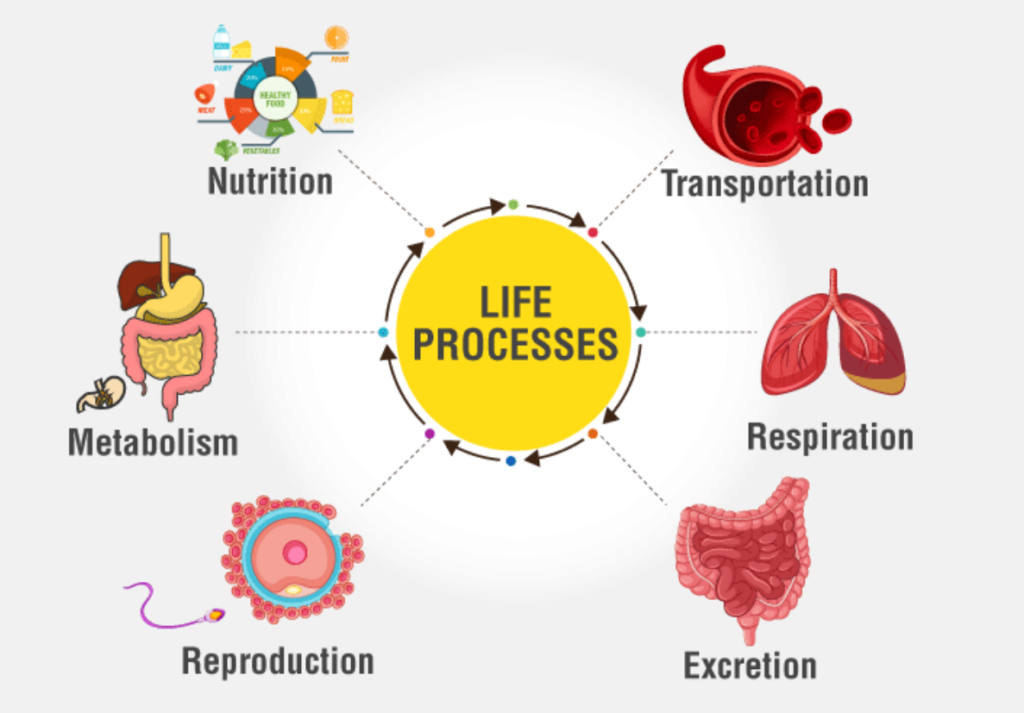
Basic Life Processes
1. Nutrition
Nutrition is the process by which living organisms obtain and utilize food to generate energy and facilitate growth. It is one of the most essential life processes, as it ensures the supply of necessary nutrients that are required for maintaining bodily functions. Nutrition is broadly classified into two types:
- Autotrophic Nutrition: In this mode of nutrition, organisms produce their food. This is most commonly observed in green plants, algae, and some bacteria that carry out photosynthesis. The process of photosynthesis involves the absorption of sunlight by chlorophyll, which facilitates the conversion of carbon dioxide and water into glucose and oxygen. The glucose produced is used for energy, while the oxygen is released into the atmosphere. Some bacteria utilize chemosynthesis, wherein they obtain energy by oxidizing inorganic substances.
- Heterotrophic Nutrition: Unlike autotrophs, heterotrophic organisms rely on consuming other organisms to obtain nutrients. This mode of nutrition can be further divided into three categories:
- Herbivores: These organisms feed exclusively on plant material. Examples include cows, deer, and rabbits.
- Carnivores: These organisms consume other animals for sustenance. Examples include lions, wolves, and eagles.
- Omnivores: These organisms can consume both plant and animal matter. Examples include humans, bears, and crows.
Unicellular organisms, such as amoeba, ingest their food through a process called phagocytosis, wherein they engulf food particles and break them down internally using digestive enzymes. In more complex organisms, a specialized digestive system aids in the breakdown and absorption of food.
2. Respiration
Respiration is the biochemical process through which energy is released from food substances, primarily glucose. It is essential for all forms of life, as it provides the necessary energy to drive other biological activities. Respiration can be categorized into two major types:
- Aerobic Respiration: This type of respiration occurs in the presence of oxygen. Glucose is completely broken down into carbon dioxide and water, releasing a large amount of energy in the form of adenosine triphosphate (ATP). This form of respiration is highly efficient and is the predominant mode of energy production in most animals, plants, and humans.
- Anaerobic Respiration: This occurs in the absence of oxygen and results in the partial breakdown of glucose, producing less energy compared to aerobic respiration. Anaerobic respiration occurs in certain bacteria, yeast, and even in human muscles during strenuous activities, leading to the production of lactic acid or ethanol and carbon dioxide.
Respiration occurs at the cellular level, where mitochondria play a critical role in energy production. The ATP generated through respiration powers other essential biological functions such as muscle contraction, nerve impulse transmission, and biosynthesis of macromolecules.
3. Transportation
Transportation is the process by which essential substances, such as nutrients, gases, hormones, and waste products, are moved within an organism. The mode of transportation varies among different types of organisms:
- In Plants: Plants possess a well-developed vascular system for the transportation of substances. The xylem is responsible for conducting water and minerals from the roots to the rest of the plant, while the phloem distributes the food prepared during photosynthesis to various parts of the plant. This process is crucial for plant growth and survival.
- In Animals: Animals rely on a circulatory system to transport essential substances. The blood, which serves as the primary transport medium, carries oxygen, nutrients, hormones, and waste products throughout the body. The heart acts as a pump, ensuring the continuous circulation of blood. The presence of arteries, veins, and capillaries facilitates efficient transport within the body.
In simpler organisms, like unicellular bacteria or protists, transport occurs through diffusion and osmosis, which involve the passive movement of molecules from areas of higher concentration to lower concentration.
4. Excretion
Excretion is the biological process of eliminating metabolic waste products to maintain internal balance, also known as homeostasis. Accumulation of toxic substances in the body can be harmful, making excretion an essential life function.
- In Plants: Plants eliminate waste products through specialized structures like stomata and lenticels. Oxygen, a byproduct of photosynthesis, is released through stomata. Excess water is expelled through the process of transpiration, which also aids in temperature regulation.
- In Animals: The excretory system is responsible for the removal of waste materials. The kidneys filter out nitrogenous wastes, such as urea, from the blood, forming urine. Other excretory organs include the lungs, which expel carbon dioxide, and the skin, which removes salts and water through sweating.
- In Unicellular Organisms: Simple organisms excrete waste through diffusion, wherein unwanted materials pass through the cell membrane directly into the surrounding environment.
5. Movement (Locomotion)
Movement is an essential aspect of life, enabling organisms to navigate their environment, find food, and escape threats.
- In Plants: Although plants are generally stationary, they exhibit various movements in response to environmental stimuli. For example, phototropism is the bending of plant stems toward light, and geotropism is the growth of roots downward due to gravity.
- In Animals: Most animals possess specialized structures for movement, such as legs, fins, or wings. Muscles and bones work in coordination to facilitate motion. Animals use movement to hunt, migrate, and interact with their surroundings.
- In Unicellular Organisms: Microorganisms like bacteria move using flagella, cilia, or pseudopodia. Amoeba extends its cytoplasm to form pseudopodia, enabling it to crawl forward.
6. Growth
Growth is an irreversible increase in size and mass due to cell division and expansion.
- In Plants: Growth occurs throughout a plant’s life and is concentrated in regions called meristems, found at the tips of roots and shoots.
- In Animals: Growth occurs up to a certain point (adulthood), and is regulated by hormones such as growth hormone (GH) in humans.
- In Unicellular Organisms: Growth involves an increase in cell size before reproduction.
7. Reproduction
Reproduction ensures the continuity of species. It is classified into:
- Asexual Reproduction: A single organism produces offspring identical to itself through processes like binary fission (Amoeba), budding (Hydra), and spore formation (Fungi).
- Sexual Reproduction: Involves the fusion of gametes, leading to genetic diversity, as seen in humans, animals, and flowering plants.
8. Response to Stimuli
Living organisms react to environmental changes to ensure survival.
- In Plants: They respond through tropisms, such as phototropism (light response) and thigmotropism (touch response).
- In Animals: The nervous and endocrine systems regulate responses to stimuli, enabling quick reactions, such as reflex actions.
Conclusion
Basic life processes are interconnected and vital for the existence of all living organisms. These processes help maintain balance, adaptation, and interaction with the environment, ensuring the survival and evolution of species. Understanding these fundamental biological functions plays a crucial role in medicine, agriculture, and environmental science.